


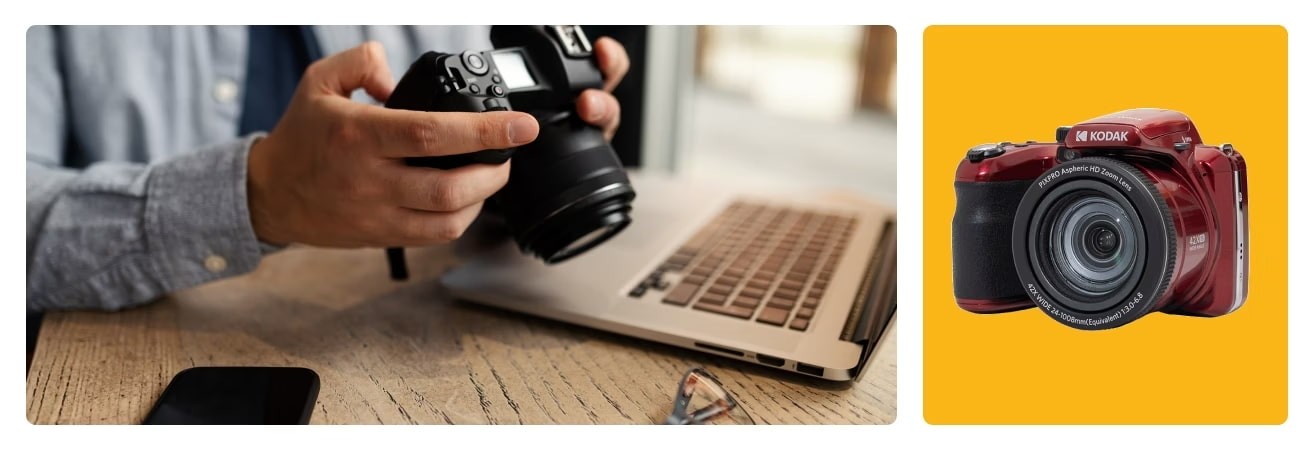
SLR or digital : how to choose your camera ?
When you want to buy equipment to take beautiful photos, you may ask yourself this question: should you opt for a reflex or a digital camera? While one evokes precision and manual settings, the other appeals for its simplicity and practicality in everyday use.
But beyond preconceived notions, it all depends on your needs, your skill level and your desire to develop your photography skills. Some people are looking for performance, others for lightness. And between compact, bridge and SLR cameras, the differences are not limited to price.
In this article, we'll help you see things clearly, with concrete explanations and a few well-chosen recommendations based on your profile. Whether you're a curious amateur, a regular traveller or a budding enthusiast, you'll find everything you need to make your choice with confidence.
DSLR or digital: what are the differences and what are they used for?
Before rushing out to buy a camera, let's take a look at what the terms ‘DSLR’ and ‘digital’ actually mean. While all DSLRs are digital nowadays, not all digital cameras are DSLRs. Here are a few simple guidelines to help you choose the right camera for your needs and preferences.
Is an SLR worth it?
SLR cameras remain the benchmark for many photographers, particularly thanks to their optical qualities. They have a mirror and an optical viewfinder, which allows for direct viewing without latency. They also offer the possibility of changing lenses to suit all types of shots: portrait, landscape, sport, macro, etc.
It is a tool that requires a minimum of practice to get the most out of it, as it often requires manual adjustments. It is therefore more suited to enthusiasts or people who are willing to invest time in learning how to use it.
In terms of size, an SLR is heavier and bulkier than a conventional digital camera. For occasional use or when travelling, it is not always the most suitable solution.
What are the advantages of digital photography?
Compact and bridge digital cameras have come a long way in recent years. They are lighter, easier to use and now offer performance that is perfectly satisfactory for most uses.
They allow you to take photos without worrying too much about technical details. The screen makes it easy to frame your shot, the settings are often automatic, and the files are easy to transfer to a computer or smartphone. They are ideal for holiday memories, family photos or even beautiful outdoor shots.
A good example is the Kodak PixPro FZ55. This compact camera combines lightness, a 5x optical zoom and a 16 MP sensor, all in an easy-to-carry format. It's a good compromise for those who want an effective, hassle-free camera.
What is the difference between an SLR and a bridge camera?
Bridge cameras fall between compact and SLR cameras. They do not allow you to change lenses, but they offer great versatility thanks to a powerful built-in zoom. It's a good solution for those who want to get closer to the world of SLRs without the constraints.
Lightweight and often more affordable, bridge cameras remain very popular with travellers and nature photography enthusiasts. They also offer more settings than compact cameras, while remaining intuitive to use.
The Kodak PixPro AZ528 is a perfect example. Its 5x optical zoom offers impressive range, ideal for landscape or animal photography. Its adjustable screen and comfortable grip also allow you to explore different framing styles, even if you're not an expert.
Are SLR cameras expensive?
This is a legitimate question, as a camera is not limited to its purchase price. In the case of SLRs, you also need to budget for additional lenses, a suitable bag, and even a tripod and cleaning kit. Over time, the investment can quickly add up.
This is where digital cameras such as bridge or compact cameras come into their own. They are often more affordable, all-in-one, and come with no nasty surprises when it comes to accessories. With a model such as the PixPro AZ255, which we will look at later, or the FZ55, you are equipped right out of the box. There is no need to change lenses or buy additional equipment. For leisure use or to gradually improve your skills, it is an economical and reassuring alternative.
Which camera should you choose to get started or for your own enjoyment?
Want to get into photography without necessarily aiming for expert level? Looking for a camera that's easy to use and can adapt to different situations? It's entirely possible today, as long as you know what you need. Here are a few pointers to help you make the right choice, whether you want to discover photography or simply have fun.
What's the best camera for beginners?
When you're just starting out, it's best to avoid cameras that are too complex. The ideal choice is an intuitive model with good ergonomics and a powerful enough zoom to allow you to have fun with complete freedom. The screen should be clear, the menus easy to understand, and the battery life reasonable enough to last a day of shooting.
The Kodak PixPro AZ425 meets these expectations and criteria. It offers a 42x optical zoom, perfect for varying your framing without moving. Its 20 MP sensor allows you to capture detailed images, and it is easy to use, even for novices. It is an excellent starting point for exploring the basics of photography, whether with your family, on holiday or on walks.
What is the best versatile camera for a beginner?
Versatility is a camera's ability to adapt to different types of situations. Portraits, landscapes, zoom, indoor or low-light scenes. For a beginner, this means being able to experiment without frustration, while maintaining a certain level of quality.
The Kodak PixPro AZ255 is one of those models that can do it all. Its 25x optical zoom allows you to capture distant scenes as well as close-up details. It is equipped with a 16 MP sensor and an optical stabilisation system, which is useful when the light is low or when you zoom in to the maximum. Lightweight and well-balanced, it offers a good compromise between comfort and performance.
How to choose between an SLR, compact, bridge or waterproof camera?
Still unsure which type of camera to choose? The choice may seem complex, but it actually comes down to a few simple criteria: how you travel, your creative aspirations, your level of photography experience and your budget. Here are some practical guidelines to help you decide.
What are bridge cameras best used for?
Bridge cameras are attracting more and more users, particularly because of their great versatility. These all-in-one models combine an impressive zoom, advanced features and a lighter format than an SLR. They offer a good compromise for those who want to go beyond simple automatic mode without investing in multiple lenses.
This type of camera is particularly popular for travel, hiking, or nature outings. Thanks to their long-range optical zoom, they allow you to capture a distant animal, an architectural detail, or a far-off peak without moving a step. All this with a user interface that is often very intuitive.
A bridge camera quickly becomes an excellent companion when you like to photograph everything without thinking too much about it. Portraits, landscapes, street scenes, action, low light. It adapts to almost any situation. Some models even offer swivel screens, perfect for framing in unusual angles or taking photos at ground level.
They are also very good cameras for learning. You can start by using the automatic modes, then learn about exposure, aperture, shutter speed and ISO sensitivity. The bridge camera then becomes a gateway to more creative photography, without the need to change cameras.
What if I want a waterproof camera for outdoor use?
Some activities require a sturdy camera. If you often go hiking, to the sea or to the mountains, a waterproof and durable model may be more suitable than a fragile or bulky SLR. It's also a good choice for families, sports enthusiasts and adventurers.
The Kodak PixPro WPZ2 is designed for these conditions. Waterproof up to 15 metres, it is also shock and dust resistant. You can use it at the beach, while snorkelling, in the rain or in the snow, without worrying. It's the perfect companion for active holidays.
SLR or digital: a choice guided by your desires
Between an SLR, compact, bridge or waterproof camera, there is no wrong choice. There is simply the one that suits your way of taking photos.
If you like technology and want to improve your skills and explore all the manual options, an SLR camera could be a great choice. On the other hand, if you're looking for a simple, practical camera that's effective for everyday use, compact or bridge digital cameras already cover a wide range of needs.
The key is to identify your priorities: ease of use, zoom, durability, budget. With this in mind, you'll find a camera that truly suits you, without frustration or constraints. And at Kodak, each model is designed to suit different profiles, from budding photographers to curious travellers.
Take the time to compare, test if possible, and above all, have fun with your future camera. Because the best photo is often the one you took at the right moment, with the camera that was at hand.