


Digital camera : essential features !
Long overshadowed by smartphones, digital cameras are making a comeback. Why? Because they offer capabilities that even high-end mobiles cannot match.
More accurate, more stable and more versatile, they meet the expectations of enthusiasts and knowledgeable amateurs alike. But you still need to know how to choose one. Between compact, waterproof and bridge models, the technical criteria can quickly become unclear.
In this article, we guide you through the world of digital photography. We zoom in on digital cameras, their advantages, their disadvantages and the best options so you never miss a shot again.
Digital cameras: definition, uses and fundamental differences
Before looking at settings or performance, let's understand what a digital camera really is. What is it used for, how does it differ from a traditional camera or a smartphone? And why do the terms ‘digital’ and ‘numerical’ ultimately mean the same thing? This first part lays the foundations for a better understanding.
What is a digital camera?
A digital camera is a device that captures images in the form of digital files. It does not use film or chemical development. Instead, light enters through the lens. It then passes through an electronic sensor (often a CMOS or CCD sensor), and the image is converted into digital data and stored on a memory card.
It is therefore a tool that not only allows you to take photos, but also to view, transfer, edit and share them very easily. Unlike film cameras, there is no need to wait for a print to see the result.
Compared to smartphones, digital cameras remain much more specialised. They offer better image quality thanks to a larger sensor, a powerful optical zoom and precise control over settings. Even a compact model such as the Kodak C1 allows for much more detailed shots than a phone, especially in low light or for photos in motion.
What is the difference between a digital camera and a digital camera?
There is none. These two terms refer to exactly the same type of device. In French, we more often refer to a digital camera. Whereas the term digital camera is mainly used in product descriptions or in languages influenced by English. Such as e-commerce or international catalogues.
At Kodak, for example, you will often see the term ‘digital camera’ on packaging and in technical manuals, as this is the international terminology. But whether you read “digital” or ‘numérique’, it always refers to a device capable of capturing and storing images in digital form.
Understanding this equivalence will help you avoid confusion when making purchases, especially online. These are therefore two words for the same concept.
What is the difference between a digital photo and a normal photo?
The distinction lies in how the image is captured and stored. A digital photo is stored as data. It can be transferred, copied, edited or printed at will. This type of photo is obtained via a digital camera, smartphone or even a webcam.
A normal photo, if we mean a classic photo on paper, usually comes from film development. The image is fixed onto film and then printed on paper using a chemical process. Each photograph is unique and cannot be modified afterwards.
Today, even so-called ‘normal’ photographs are often produced from a digital file. This is referred to as a photo print. A digital image is printed, which offers the freedom to choose the format, quality or medium.
Digital photography also allows for immediate processing. You can adjust the brightness, crop the image, remove a flaw or add a filter. A camera such as the Kodak PixPro FZ55, for example, offers built-in editing options. These include brightening the eyes or removing red-eye.
Why choose a digital camera today?
You might think that smartphones have replaced traditional cameras. However, digital cameras are still ahead in many ways. For those who love photography or want to capture high-quality memories, investing in a real camera is still a wise choice. Let's take a look at why.
Why buy a camera today?
Above all, a digital camera offers superior image quality. Even compact models have larger sensors than smartphones. The difference is noticeable. Details are sharper, contrasts are more balanced, and photos are brighter even when there is not enough light.
The other big advantage is the lens. Whereas a phone simulates zoom with digital magnification (and therefore a loss of quality), a camera uses a real optical zoom. This changes everything. You can get closer to your subject without moving, while maintaining a clean image without pixelation.
Battery life is also an advantage. A camera's battery is designed solely for photos and videos. It therefore lasts much longer than a smartphone's battery in camera mode.
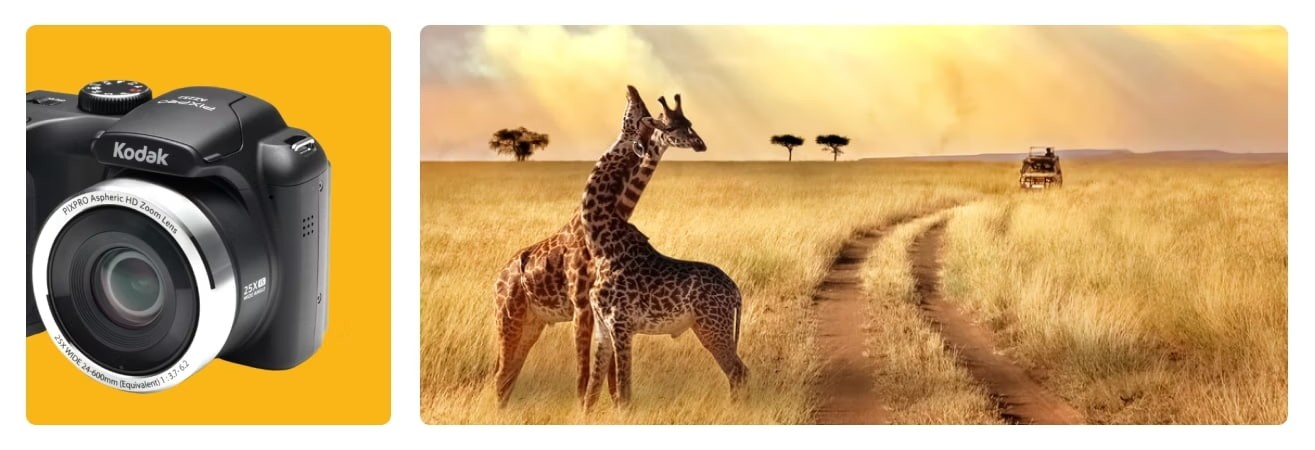
Let's take a concrete example: the Kodak PixPro AZ528. This bridge camera combines the advantages of an SLR with the simplicity of a compact camera. It is equipped with a 52x optical zoom and a 24 mm wide angle. This allows you to photograph a very wide scene, such as a landscape, or, conversely, to capture a wild animal in the distance without losing sharpness. It's an excellent choice for travel, safaris, concerts or sporting events, where it's not always possible to get close to the subject.
What are the four main types of digital cameras?
To choose the right digital camera, it's important to know the main types of cameras. Each one is designed for a specific level of skill and use. There is no universal best choice, only the one that best suits your needs.
The first category is compact cameras. They are designed for beginners or family use. Simple to use, lightweight and easy to carry, they often fit in a pocket.
Next comes the bridge family, designed for passionate amateurs. These cameras resemble SLRs, but with a fixed lens. They stand out for their powerful optical zoom, comfortable grip and advanced options. They offer a good compromise between simplicity and performance.
Hybrids form a third family. They allow you to change lenses while remaining lighter than an SLR. They have a digital viewfinder, fast autofocus, and offer plenty of room for improvement.
Finally, SLRs (or DSLRs) are designed for experienced photographers. They have an optical viewfinder, a very large sensor, and allow total control over the image. Their weight, price, and learning curve make them demanding tools, but they are extremely effective. Kodak does not sell SLRs, but it is useful to be familiar with this range in order to properly understand the other models.
Kodak compact and bridge cameras cover the most common needs. They offer a real alternative to smartphones for those looking for quality without complexity.
Features to know when choosing a digital camera
When looking to buy a digital camera, it is easy to get lost among the technical specifications. However, there are a few essential elements that will help you make an informed choice. Speed, light, battery life, ease of use... Here are the criteria to look at closely, as well as the basic settings you need to master in order to progress quickly.
What are the three most important settings on a camera?
A good shot often depends on three key factors. This trio of settings allows you to control light and sharpness. Shutter speed, aperture and ISO sensitivity.
The shutter speed controls the amount of time the sensor is exposed to light. A fast speed freezes movement, such as a footballer in the middle of a shot. A slower speed, on the other hand, can capture the blur of movement, such as a waterfall in a long exposure.
The aperture affects the depth of field. A large aperture (f/2.8, for example) allows you to separate the subject from the background, which is ideal for portraits. A small aperture (f/11 or higher) is preferable for landscapes that are sharp throughout the entire scene.
Finally, the ISO controls the sensor's sensitivity to light. In broad daylight, you'll want to stay around 100 or 200 ISO. Indoors or in the evening, you can go up to 1600 or even 3200. The higher the ISO, the more light is captured, but at the risk of a little graininess.
Some cameras make it much easier to access these settings. The Kodak PixPro FZ55, for example, offers a manual mode that allows you to precisely adjust these three settings. This type of configuration is perfect for users who want to learn or experiment without switching to a camera that is too complex.
What criteria should be considered when choosing a digital camera?
Beyond the settings, several technical criteria can guide the choice of a camera that is suited to your needs.
The first criterion that is often highlighted is resolution, expressed in megapixels (MP). For everyday use (photo albums, A4 prints, social media), a resolution between 12 and 16 MP is more than enough. All the Kodak models mentioned here already meet this criterion.
The type of zoom is just as important. An optical zoom allows you to enlarge an image without losing quality. A digital zoom, on the other hand, acts like software cropping. The image is enlarged, but becomes less sharp. For this reason, an optical zoom is preferable.
Also consider battery life, especially if you plan to take a lot of photos on the go. Some models, such as the Kodak FZ45, run on AA batteries, which can be handy when travelling abroad. Others, such as the FZ55, use a rechargeable lithium-ion battery.
The type of battery can make a difference depending on the intended use. For outdoor activities, it is best to opt for a sturdy, waterproof camera.
This is the case with the Kodak PixPro WPZ2, designed to be waterproof up to a depth of 15 metres. It is ideal for families going to the beach or swimming pool. With its reinforced shell, it can withstand splashes and accidental drops.
Finally, remember to check whether the camera offers a macro mode, which is useful for photographing objects up close, or image stabilisation. This is very useful for avoiding blurring when zooming.
What is a modern camera?
Today, a digital camera is no longer limited to taking pictures. It has become a connected and intuitive tool, with features designed to make everyday use easier.
Among the interesting options, the tiltable screen allows you to take photos from a variety of angles. Very handy for selfies, vlogs or solo videos. The Kodak C1, for example, is equipped with a 180° tilting screen, perfect for framing yourself accurately without assistance.
Face recognition is another feature that makes portraits sharper. The camera automatically detects a face, adjusts the focus and sets the exposure. Some models go even further with smile or closed-eye detection.
Wi-Fi connectivity allows you to transfer your images directly to a smartphone or tablet without a cable. These small innovations save time and improve user comfort. They are useful for beginners, but also appreciated by experienced amateurs who want to work quickly and efficiently.
Advantages and disadvantages of digital cameras
Choosing a digital camera means weighing up the pros and cons. Like any piece of equipment, it has its strengths but also its limitations. Before investing, it is useful to have an overview so that you can make an informed decision. Here's what you need to know.
What are the advantages of digital photography?
Digital photography also offers many everyday benefits. Storage is unlimited. With a good memory card, you can store hundreds or even thousands of photos. And if necessary, you can simply transfer the files to a computer or hard drive.
Sharing images is also very easy. You can send photos by email, post them on social media or print them online.
Editing is another strong point. Is a photo a little dark? Does the framing need to be adjusted? With just a few clicks, you can improve the result without any technical knowledge.
Some cameras already have advanced features built in. The Kodak FZ55, for example, offers an HDR mode to balance the light, burst shooting to capture movement, and scene modes adapted to each situation. It also recognises faces and automatically adjusts the settings.
Finally, the flexibility of the digital format allows you to test, retry, experiment... without wasting film.
What are the disadvantages of a digital camera?
Despite all its advantages, a digital camera requires a little care.
First, you need to think about maintenance. The lens must remain clean to ensure a sharp image. A simple microfibre cloth is sufficient, but you need to do this regularly.
Next, you need to manage your files. Photos take up space, so you need to sort, save, and sometimes rename or classify your shots. This can be time-consuming, especially after a long trip.
Finally, there are a few additional costs to consider. An SD card is essential, and it is best to invest in a fast and reliable version. If the camera runs on batteries, a spare battery may be useful. These small accessories are not always included.
Despite this, these constraints are limited, especially when you know why you are buying the equipment. To avoid unpleasant surprises, it is best to choose the right equipment from the outset.
Choosing the right digital camera so you never miss a moment
Investing in a digital camera means choosing quality and freedom.
By learning to identify the right features, you can avoid unpleasant surprises. By understanding your needs, you can choose a model that is suited to your use. And at Kodak, there is a solution for every profile. From compact cameras that slip easily into a bag to powerful bridge cameras that push the limits of zoom.
Taking a beautiful photo is no accident. It is a balance between technique, instinct and equipment. The camera isn't just there to look pretty. It's there to capture what the eye sees, what you feel at the precise moment you press the shutter button. And with a good digital camera, all of this becomes easier, smoother and more accurate.
So, whether you're on holiday, out in the countryside or with your family, don't forget that your vision deserves a camera that can keep up with it. It's up to you.