


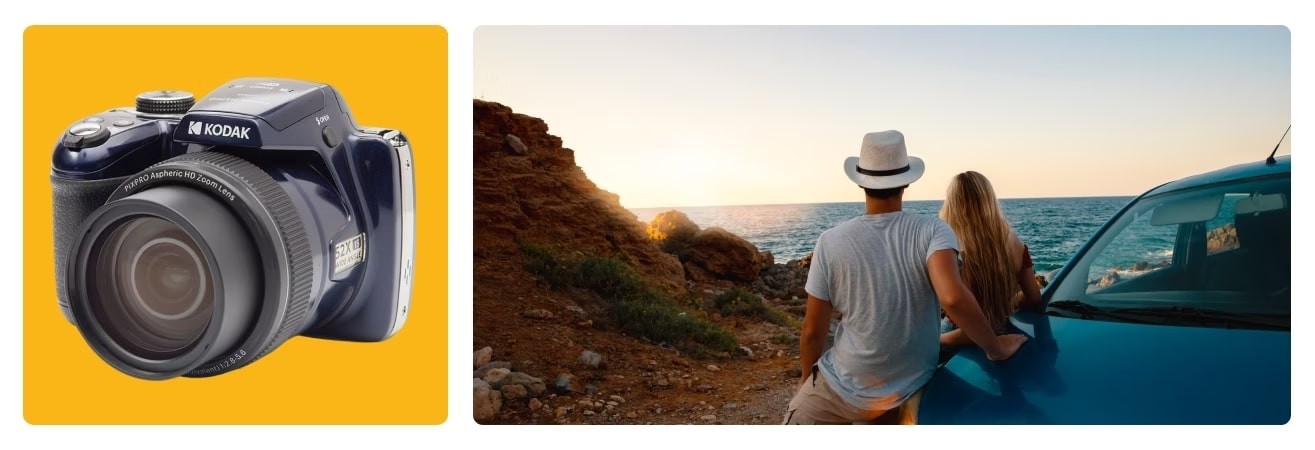
Road trip: 5 mistakes to avoid with your camera
A road trip promises escape, freedom and precious memories captured along the way. But to ensure that each shot truly captures the adventure, it's best to avoid some common pitfalls. Choosing your equipment, preparing, transport, battery life... mistakes are sometimes minor, but they can ruin great opportunities. Here are 5 mistakes to avoid when travelling with your camera on a road trip, along with some simple tips to ensure you set off with peace of mind and well equipped.
1. Taking a camera that's not suited to your road trip
Going on a road trip often means living with the unexpected. Between winding roads, stunning views, impromptu stops and changeable weather, the camera you take with you needs to keep up without faltering.
If it's too heavy, too fragile or poorly equipped, the wrong camera can quickly become a burden rather than a friend. Being well equipped from the start gives you the freedom to enjoy taking photos wherever you are.
Lightweight and versatile: the key words
When travelling by van, car or backpack, every gram counts. You want a compact camera that's easy to slip into a bag but capable of taking beautiful pictures with minimal effort. That's where the Kodak PixPro AZ405 and AZ528 bridge cameras make all the difference. They're lightweight, intuitive to use and ready to shoot at a moment's notice, whether you're capturing a landscape, a portrait or a street scene.
The Kodak PixPro AZ405 is ideal if you're looking for a good compromise between performance and simplicity. It's perfect for those who want to capture their travel memories without spending too much time on settings. Compact and efficient, it fits easily into a day bag.
A camera tailored to your photography needs
Do you like photographing mountains, wild coastlines or animals you come across on your travels? The Kodak PixPro AZ528 is designed for travellers who want to take their photography a step further. It features a more powerful zoom, a tilting screen and a high-performance sensor, perfect for playing with contrasts or capturing details from a distance. Its compact size and long battery life make it reliable for long days out.
For the more adventurous, those who combine beach, hiking or camping with their road trip, the Kodak Pixpro WPZ2 is the ideal companion. Waterproof, durable and easy to use, it is designed to withstand water, dust and shocks. It is perfect for adventurers who like to get close to nature without fear of damaging their equipment.
Adapt your equipment to your itinerary
A road trip in Norway, the Calanques or the Irish coast does not have the same photographic constraints. The light, humidity and accessibility of locations change everything. If you are travelling light, you need a road trip camera that won't slow you down but will enhance your journey. So choose a model that won't weigh you down, with a long battery life and real versatility.
It's often the little details that make the difference: a comfortable viewfinder, a high-quality optical zoom, or a screen that's easy to read even in bright sunlight. These are features found in most Kodak PixPro models, designed to follow you everywhere and adapt to any situation.
2. Neglecting essential travel accessories
When going on a road trip, we often think about the essentials: camera, lens, memory card. But we sometimes forget the little accessories that make all the difference in the field. One oversight and you're guaranteed to have a breakdown or a nightmare. To travel with peace of mind, it's best to take a few essentials with you.
Bring extra batteries
If your battery dies while you're out hiking or sightseeing, your camera is useless. To avoid this, it's best to bring one or two spare batteries, available individually. Some Kodak models, such as those in the AZ range, also work with AA batteries, which are easy to find anywhere. And if you opt for a rechargeable camera, check that it is compatible with a USB port, which is handy for recharging in the car or with an external battery.
Never run out of memory
Taking photos in optimal quality requires space. Opt for a high-capacity memory card (32 GB minimum, 64 GB recommended) so you don't have to sort through your photos while travelling. Better still, take a second card with you as a backup. That way, you can switch between them without any hassle.
Think about protecting your equipment
A good microfibre cloth is essential for cleaning your lens without damaging it, especially after shooting by the sea or in the mountains. A shockproof case will protect your camera from knocks in the van or in your backpack. And if you plan on taking pictures at sunrise or sunset, a small travel tripod can be very useful for stabilising your shots.
A waterproof bag or protective cover quickly becomes essential if you are travelling by van, bike or on foot. It keeps your camera safe from rain, dust and shocks. It's a simple habit that can prevent a lot of unpleasant surprises.
Save time with a dedicated pouch
Finally, consider organising your equipment in a dedicated camera pouch. You can store batteries, cards, cloths, cables and accessories in it. No more rummaging through your bag at every stop. You'll save time and be sure you haven't forgotten anything.
3. Forgetting to check the settings before you leave
When you're setting off on a road trip, the excitement of the journey can make you forget the essentials, such as setting your camera correctly. However, a quick check before you hit the road can save you a lot of disappointment.
Test the modes before you leave
Each camera offers different photo modes: landscape, portrait, low light or panorama. Taking the time to test them at home will help you understand them better. This way, you'll know what to choose depending on the light or the scene you want to capture, without having to fumble around when you get there.
Know how to manage your camera's basic settings
Even if you're shooting in automatic mode, knowing a few basics such as ISO, white balance and focus can make all the difference. Poorly managed lighting or incorrect focus can ruin an image that you won't be able to recreate.
Use the optical zoom properly
The digital zoom, which is often used incorrectly, degrades image quality. The right thing to do is to use the optical zoom, which allows you to get closer to the subject without losing sharpness. On Kodak compact and bridge cameras, such as the AZ405 or AZ528, this feature is smooth and easy to master.
4. Poor light management
When travelling, the light is constantly changing. It can magnify a landscape... or make it look completely flat. Knowing how to play with light is essential for taking great photos, especially when exploring places you may not see again anytime soon.
Morning and evening light are your best allies
The golden hours, early in the morning or just before sunset, offer soft, warm light. It's ideal for capturing the contours, textures and contrasts of a landscape. In the middle of the afternoon, on the other hand, the light is often harsh, especially in summer. It's best to look for shaded areas or slightly lower the exposure to avoid overexposed images.
Compact and bridge Kodak cameras, such as the AZ528, allow you to easily adjust the brightness. With a manual or semi-automatic mode, you can control the aperture, shutter speed or ISO depending on the situation.
Learn to read your environment
Look around you. Where is the light coming from? What shadows does it create? Sometimes, simply walking a few metres is enough to completely change your angle and enhance the scene. Take your time, observe and try out different compositions.
Exposing your subject correctly
If the sky is very bright and the ground very dark, the camera may struggle to balance everything. Some Kodak models offer easy-to-use exposure settings to prevent your subject from being too dark or too light. In high-contrast scenes, you can also activate the HDR (high dynamic range) function, available on some models, to preserve details.
5. Don't save or sort your photos during your trip
When travelling with your camera, you can quickly accumulate hundreds of photos. However, few travellers take the time to sort or save them as they go. This is often a mistake. A simple bug, theft or mishandling can cause all those memories to disappear.
Get into the habit of sorting your photos every day
In the evening, after a day of driving or sightseeing, take a few minutes to look through your photos. Delete any duplicates, blurry shots or ones you don't like. You can also rename the files or organise them into folders. This little ritual will save you precious time when you get home and help you visualise your trip better.
Back up... and bring your photos to life
Don't just rely on your memory card. It can fill up, get lost or damaged. Remember to back up your images regularly, either to the cloud if you have a network connection, or to a compact external hard drive. This will protect your memories, even in the event of a technical problem.
And to take things further, why not print your photos on the AgfaPhoto Print website? It's a great way to bring your photos to life and share them in a way other than on a screen.
Take advantage of your camera's connected features
If you use a camera such as the Kodak PixPro AZ528, you can transfer your photos to your smartphone or tablet via Wi-Fi in just a few clicks. This is handy if you want to share an image quickly or simply make a backup on the fly during a coffee break or train journey.
Conclusion: travel light, but take great photos
A camera is not just a technical tool, it's a travel companion. It keeps track of landscapes, encounters and happy surprises. But to get the most out of it, it's best to avoid common mistakes.
Good preparation, a little foresight and, above all, the right equipment for your needs can make all the difference. Models such as the Kodak PixPro AZ405 or the AZ528 are perfect for capturing every moment without complications. Versatile, lightweight and intuitive, they keep pace with your desires without ever holding you back.
Whether you're immortalising a road trip with friends, a mountain getaway or a sunrise over the ocean, they offer you true creative freedom.
In photography, as in travel, it's all about attention and simplicity. So before you pack your bag, think about your camera... and what it will allow you to tell, image after image.