


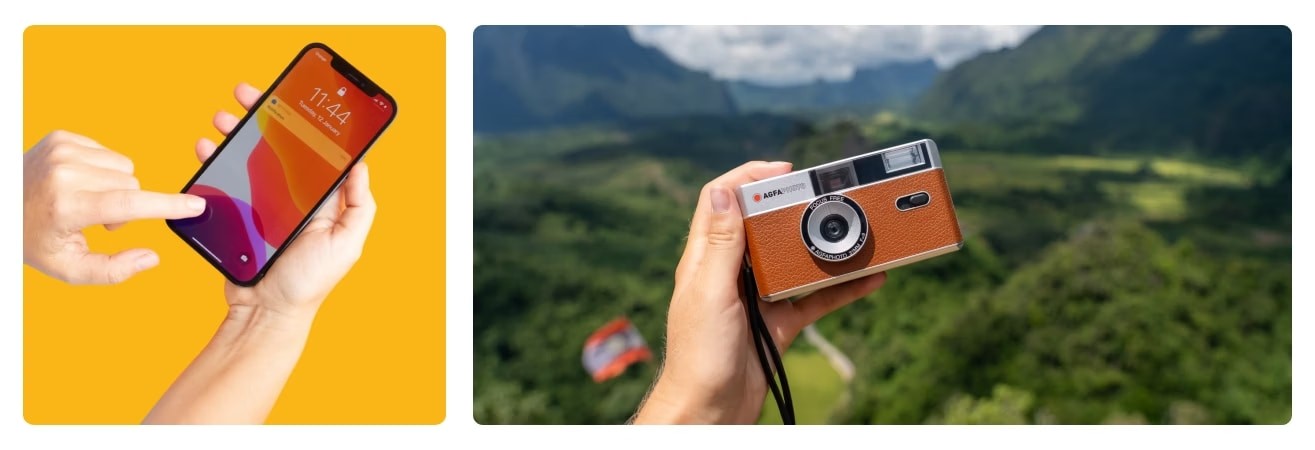
Is there still a need for a camera in the age of smartphones ?
Nowadays, everyone has a camera in their pocket. Smartphones have become the go-to device for capturing everyday moments. Easy to use and always at hand, it only takes a few seconds to take a photo and share it.
But this ease of use also raises a real question. Have smartphones definitively replaced cameras? Are we losing something by no longer using a dedicated device?
This is a divisive topic, as it touches on technology, convenience, and also the way we view and photograph the world. Choosing a camera in addition to a smartphone is not a step backwards. Sometimes it's simply choosing a different approach.
Is it worth buying a camera?
At first glance, smartphones and cameras do the same thing: they capture images. But beyond this commonality, there are significant technical differences that influence image quality, ease of use, and the way we approach photography.
Educational breakdown: sensor, zoom, software processing, file formats
A smartphone uses a small sensor, often combined with several lenses. Its strength lies in software processing. Thanks to artificial intelligence, it analyses the scene, adjusts colours, reduces blur and improves brightness. This is what gives that feeling of immediate sharpness, even without any adjustments.
In contrast, a camera relies on more specialised components. The sensor is generally larger, allowing it to capture more light and detail. The zoom is often optical, so there is no loss of quality, unlike the digital zoom on smartphones.
Finally, the files produced are different. A camera can save in JPEG, but also in RAW, an uncompressed format that allows images to be edited without altering their quality.
Smartphones focus on immediacy and artificial intelligence
The advantage of smartphones is their speed. They are always ready to use. A simple tap on the screen is all it takes to take a photo, edit it and publish it.
Everything is designed for instantaneity. The device automatically adjusts exposure, focus and contrast. It even optimises the sky, faces and background using powerful algorithms.
But this automation has its limits. It sometimes smooths textures too much, alters colours and leaves little room for personal interpretation.
The camera retains the advantage of optical precision
In contrast, a camera offers a more refined approach. It allows for better management of depth of field, complex contrasts and high-dynamic areas, such as backlighting or poorly lit scenes.
The quality of the optics plays an essential role. The rendering is often more natural and true to life. The image is not simply ‘enhanced’; it is better constructed from the moment it is taken.
It is in demanding scenes such as low light, movement or close-up portraits that the gap between the two really widens.
Focus on the Kodak PixPro FZ45
The Kodak PixPro FZ45 is a good example of this transition between smartphones and dedicated cameras. Compact and lightweight, it remains easy to use, while offering features that smartphones do not always have.
Its 4x optical zoom allows you to get closer to your subject without losing sharpness. This detail makes all the difference, especially when travelling or taking outdoor portrait photos, where you want to isolate your subject without distorting the background.
In low light situations, the camera handles contrast better without flattening everything. And it gives you access to additional settings, which are useful for improving your skills while remaining in an accessible format.
The camera, a tool designed for photography
A camera is not just a sensor. It is an object designed to capture images in all situations. Where smartphones seek to keep things simple, cameras focus on efficiency, comfort and precision when taking pictures.
Ergonomics, comfortable grip, responsive camera shutter
Taking a photo with a camera is also a question of movement. The grip is more stable and natural. The body fits the shape of the hand, and the shutter button falls under the fingers.
The shutter is often more responsive, with less latency than a touchscreen. This allows you to better capture the moment, especially when it won't happen again.
The buttons are placed where they need to be for quick access to settings. You can stay focused on the scene without searching through menus.
The camera has better stability and grip
When taking photos outdoors, on the move or in less comfortable environments, the difference is noticeable. A camera offers better stability, which limits unwanted blurring.
Its weight, often slightly heavier than a smartphone, works in its favour. It absorbs micro-movements better, especially when shooting handheld.
Even in windy, rainy or changing light conditions, the camera maintains a certain consistency in shooting. It is more resistant to the elements.
The importance of the viewfinder, dedicated controls and camera battery life
The viewfinder, when present, helps you frame your shot without distraction. It also allows you to see the exposure and details better, even in bright sunlight.
Physical controls provide direct access to essential settings such as zoom, light and white balance. This gives you more control without having to navigate a screen saturated with options.
Battery life is also a real strong point. Whereas a smartphone can quickly run out of power after a few hours of use, a dedicated camera lasts much longer. This is reassuring, especially when travelling.
Take photos anywhere with the Kodak PixPro WPZ2
A good example of these advantages is the Kodak PixPro WPZ2. Waterproof up to 15 metres, it is designed for outdoor activities, beach holidays or walks in the rain.
Where a smartphone would require an expensive case or would have to stay at the bottom of your bag, this camera can be submerged, withstand humidity and continue to produce sharp images.
Its compact size, robustness and ease of use make it a great choice for active families or nature lovers. It frees photography from its usual limitations, which is exactly what you'd expect from a dedicated camera.
Rediscover the value of photography with a real camera
Nowadays, it's easy to take lots of photos. We whip out our smartphones and snap away, often without really looking. But photography isn't just about capturing images. It's also about observing, framing and choosing. A camera restores the importance of this process.
Smartphones encourage us to accumulate photos without really looking at them
With a smartphone, we photograph everything, all the time. All it takes is a swipe of the finger to take a picture. We take ten shots of the same scene (and fill up our storage space!), relying on artificial intelligence to sort or enhance them.
This immediate convenience can make photography automatic. We capture without thinking. The images accumulate in the gallery, but we forget them almost immediately.
The technical quality is there, but the construction of the image often takes a back seat.
The camera invites you to slow down, frame the shot and observe
When using a camera, the gesture becomes different. You take the time to look at the scene. You think about framing your photo well, the background, the light. You don't just snap away at random.
This time spent observing changes the way you photograph. It creates a stronger link between the gaze and the image. Even with a simple camera, you learn to be more attentive.
This doesn't mean you have to master everything, but simply that you choose to take a real photo, not just a quick snapshot.
Photography as a creative practice
Photography is also a way of expressing yourself. You can play with shadows, look for a different angle, wait for the right light.
By taking the time to compose, you give the image meaning. Each photo becomes a small choice, a view of the world.
Even without technical knowledge, this approach helps to create images that tell a story. And that's often what makes the biggest impression.
The Kodak C1 Compact, a good compromise
To discover this approach without complicating your life, the Kodak C1 Compact is a good place to start. Lightweight and easy to use, it allows you to learn photography in a different way.
Its 4x digital zoom offers initial freedom of framing. And its compact size means you can take it anywhere, without any constraints.
It's the ideal camera for a curious teenager, a student travelling, or anyone who wants to learn to see things differently. It encourages you to slow down, find the right angle, and make photography a more conscious activity.
Instant, bridge, compact: each use has its own dedicated camera
While smartphones try to do everything, cameras can specialise. That's precisely what makes them so valuable. There is a wide variety of models, each designed for a specific use. Instant, compact or bridge, each format offers a different experience.
The strength of the camera range is its specialisation
When choosing a camera, we are not necessarily looking to replace our smartphone. We are looking to complement it. The idea is not to have a tool for everything, but a tool that is well suited to what we like to do.
This is where specialisation comes into its own. Some cameras are designed for action, others for sharing memories, or even for technical improvement.
And in each of these cases, the photographic experience changes. It becomes more focused, more engaging, sometimes even more fun.
When a bridge camera becomes a powerful tool for progress
At the top end of the range are bridge cameras. Closer to SLRs, they offer real comfort in the hand and a wide range of settings. They are a good choice for enthusiasts who want to go further without switching to a professional system.
The Kodak PixPro AZ528 is a good example. Its 52x optical zoom allows you to capture birds in flight, distant landscapes or even details invisible to the naked eye.
It is the ideal tool for a photo safari, a mountain hike, or simply to explore your surroundings in greater depth.
Where a smartphone quickly reaches its optical limits, this type of camera continues to offer sharp, detailed possibilities without compromise.
Rethinking how we take photographs in the smartphone era
Smartphones have changed our relationship with photography. They have made taking pictures easier, more immediate and more connected. But this ease can also distance us from the pleasure of taking photographs with intention.
Choosing a camera today is not a step backwards. It is another way of capturing what matters. We take the time to frame the shot, find the right light, make a choice.
Compact, instant, waterproof or ultra-zoom, each camera offers its own solution, tailored to a need, a desire, a situation. It's not a question of opposition, but of complementarity.
By rediscovering the value of the act of photography, we give new weight to the image. And sometimes, that's what changes everything.