


What equipment do you need to film sports ?
No matter what sporting event you want to film, you need to be prepared. It's not enough to just have a camera handy; it also needs to be suited to the action, the lighting and fast movements. Sometimes even extreme conditions...
Nowadays, anyone can capture their own exploits or those of others. But to achieve smooth, sharp and striking results, you need to know what to use and how to use it. Do you need an expert zoom? An on-board camera? Advanced stabilisation? Choosing the right equipment depends mainly on the sport and the environment. Of course, you also need to consider what you want to convey in the image.
Let's try to clarify things so you can get the right equipment, with practical advice, examples of use and tips to enhance your sports videos. Follow the guide.
Preparing your equipment for filming sports
It's very important to have the right equipment to capture the intensity of the sport without compromise. Before you even think about editing or uploading, you need to choose the right tool for what you want to film. The type of sport, the distance from the action, and even the weather are all factors to consider to avoid unpleasant surprises.
Adapt your equipment to the sport you are filming
Filming a football match does not require the same equipment as filming a snowboard run or a kayaking trip. Each sport has its own technical constraints. The key is to adapt your equipment to what you want to capture.
For board sports such as skiing or downhill mountain biking, an on-board camera mounted on a helmet or handlebars allows you to capture immersive images. In this type of situation, stability is essential to avoid blurry or shaky videos. Here, a lightweight, durable camera that can absorb shocks is preferable.
In team sports, the challenges are different. The videographer is often far from the action and must follow fast-moving events without losing any details. They therefore need a camera with a powerful zoom, capable of following movements smoothly and fluidly. A high frame rate is a real bonus, especially for replaying highlights in slow motion.
And when water comes into play, the need for waterproof equipment becomes obvious. Whether filming paddleboarding, surfing or a simple water fight, a camera that is resistant to moisture and pressure is essential.
To explore these use cases in more detail, the article Cameras, sports and adventure: which action camera should you take on your outings? explores the best options for your activity in detail.
Camera settings for filming sports
A good sports video depends not only on the camera, but also on its settings. Too often, we underestimate the impact of poor configuration on the final quality.
Resolution is the first criterion to consider. Full HD remains a good standard. But for those who want to crop or project their videos, 4K provides welcome additional precision. It also allows you to maintain sharpness even when zooming in slightly during post-production.
Another very important point is fluidity. For filming sports, we recommend a minimum of 60 frames per second. This ensures a more natural rendering of fast movements. For slow motion, some models go up to 120 fps or even higher. This capability gives you real creative freedom when editing.
Finally, stabilisation makes all the difference. A shaky video can quickly become difficult to watch. More and more devices offer optical or digital stabilisation, sometimes both. This dual system smooths out jolts, even when the camera is in motion.
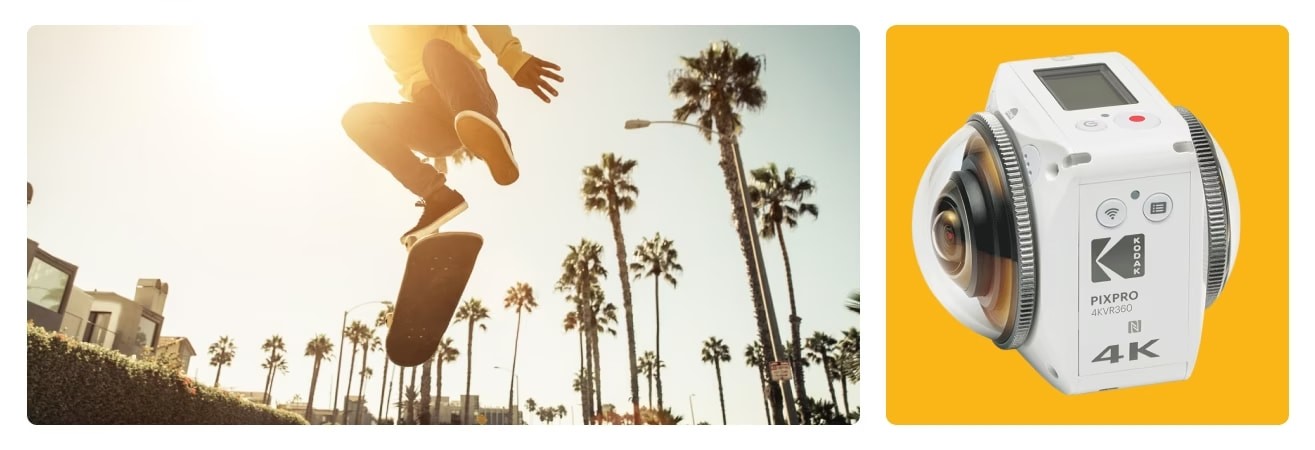
The Kodak PixPro SP360 4K Action with dual pro pack perfectly meets this technical requirement. It has the ability to film in very high resolution with an immersive wide angle, all combined with effective stabilisation. On top of all that, it can film in 360° for total immersion when rendering the scene. All these advantages make it the perfect choice for filming the most action-packed situations, whether mountain biking, surfing or paragliding.
Which camera should you use to film sports?
Whether you're in the stands or in the thick of the action, your equipment must meet specific technical criteria. Size, zoom, durability, sensor type... There are several factors to consider depending on the environment and the type of sport being filmed.
Each configuration has its advantages, provided you know exactly what you need.
Which lens should you use to film sports?
In many sports, the distance between the videographer and the action can vary considerably. This is particularly true in stadium sports such as football or rugby, where you cannot get close to the players. To obtain sharp, dynamic images, a powerful optical zoom is essential.
A telephoto lens allows you to frame the shot tightly without physically getting closer. This avoids the loss of quality associated with digital zoom, which is often too aggressive to produce a clean image. Cameras with a 40x optical zoom or more offer great flexibility to adapt to variations in distance without moving from your position.
In other contexts, such as a skatepark or sports hall, a shorter focal length is preferable. It allows you to capture the environment and movements without distorting the perspective. It also gives you more freedom to film from above or below, angles often used to enhance the sense of movement.
The Kodak PixPro AZ528, a versatile camera for demanding creators, fits perfectly into this mindset. Its 5x optical zoom allows you to capture sharp details at a great distance without sacrificing image quality. This is a real asset for those filming competitions outdoors or from the stands.
What camera format should you choose for filming sports?
The choice of format depends largely on the sport being filmed, but also on the videographer's position. Some cameras are designed to be worn on the body, while others are designed for more traditional handling. Each has its own role to play.
For sports in which you are directly involved, such as skiing, paragliding or cycling, on-board cameras are often the most suitable. They can be easily attached to a helmet, chest or handlebars and capture immersive images close to the action. Their compact size and light weight make them easy to carry without hindering movement.
In a more family-oriented setting, or for filming several types of activities, a compact and durable camera may be more versatile. It is easier to handle, works well in automatic mode and can often withstand a variety of weather conditions, even extreme ones. One example is the Kodak PixPro WPZ2, which is waterproof to a depth of 15 metres. It is perfect for water sports or dusty environments.
Its compact size means it can be slipped into a pocket or bag, while still delivering great image quality and good shock resistance.
Techniques and tips for successful sports videos
Beyond the equipment, it's the choice of framing, shots and pace that will give your sports videos impact. A good sports video doesn't just narrate an action, it conveys energy, atmosphere and emotion. To achieve this, you need to think in advance about how you are going to film and the effect you want to create. Here is an overview of best practices.
How to film sports
Filming a sports scene is above all about learning to follow the movement without being overwhelmed by it. Good framing guides the eye, highlights the effort and captures the intensity of the moment.
Each shot has its own function. A low-angle shot, for example, gives scale to a jump or an acrobatic move. It reinforces the power of the movement. Tracking shots, often used in mountain biking or running, follow the subject while keeping the background in motion. This gives a real sense of speed. Finally, static shots are often underestimated, but they work very well for team sports. It allows you to capture complete actions with a certain stability, especially at the edge of the field. It is entirely possible to attach an action camera to a drone to capture breathtaking shots. This will also help you to achieve variety in your shots. For example, the Kodak PixPro SP360 4K with its Aerial Pack allows you to capture these types of highly trendy and ultra-dynamic images. This will allow you to film sports in a different way, significantly raising the level of your shots.
In any case, it is important to think about the variety of shots. Alternating angles makes the final video more dynamic. This sometimes requires anticipating movements or testing several positions before finding the one that works best.
Recording sound when filming sports
When filming sports, sound is often relegated to the background. However, it remains very important in creating a sense of realism. The sound of footsteps, the breath of exertion, the atmosphere of the crowd... all these elements enrich the video.
In an outdoor or noisy environment, it can be difficult to capture clear sound with the camera's built-in microphone. That's why using an external microphone is recommended, especially for interviews or scenes on the sidelines. Today, there are compact microphones that are easy to attach to the camera or wear discreetly.
When audio recording is not possible, or if there is too much interference, sound editing becomes a necessary step. You can add a dynamic soundtrack, sound effects or even a voice-over to contextualise the action. This helps to structure the video while enhancing its intensity.
The important thing is to maintain consistency between the rhythm of the video and the sounds chosen. Music that is too slow or too fast can break the dynamic. It is better to opt for a soundtrack that accompanies the movement without dominating it.
Getting the right equipment for filming sport
Filming sport is not just about documenting a performance. It's about capturing a moment of intensity, revealing the beauty of a movement or bringing an emotion to life. To do this, you need the right equipment, mastered settings and a clear vision of what you want to convey.
Whether you're on the field, on the track or in the water, your camera becomes an extension of your gaze. It must keep up with the pace, adapt to constraints, but also give you the freedom to create. Everyone can find the equipment that suits their practice. This is particularly true thanks to the many options offered by Kodak, especially its selection of sports cameras that can help you meet any challenge.
As you can see, whether you choose an on-board camera, a waterproof compact camera or a model with a powerful zoom, take the time to choose what's right for you, try out different shots and, above all, have fun. Because the best videos are often those that come from a simple desire to share a passion.