


Definition : What is a mirrorless camera ?
The world of photography is evolving rapidly, and with it, the cameras that allow us to capture ever sharper, richer and more expressive images. Among these tools, the mirrorless camera has carved out a place for itself. Neither quite an SLR nor completely compact, it combines the best of both worlds.
But who are they really for? How do they work? And how do they differ from other cameras such as bridge cameras or SLRs? To better understand the appeal of this type of camera, it is essential to define its characteristics, explain its advantages and guide each user in their choice.
Hybrid camera: definition, operation and specific features
Before deciding whether a hybrid camera is right for you, let's take a look at what really defines it. Its name may be confusing, but behind this term lies a whole category of cameras in their own right. With their own technical and practical advantages.
What is a hybrid camera?
A hybrid camera, also known as a mirrorless camera, is a camera with interchangeable lenses that does not have a mechanical mirror, unlike reflex cameras. The absence of a mirror allows for lighter and more compact camera bodies to be designed. All while maintaining image quality that is close to, or even equivalent to, that of reflex cameras.
Most hybrid models are equipped with a large sensor, often APS-C or a full-frame sensor. They feature high-performance autofocus, a handy swivel screen for framing, and sometimes an electronic viewfinder that simulates the view of the scene in real time. These cameras are designed to offer a complete photographic experience in a more mobile format.
Hybrid or something else? Different types of cameras
Before you rush out to buy a hybrid camera, it may be worth finding out about the other options available. Each type of camera is designed for different uses. Understanding these main categories will help you choose a model that suits your photography style.
What are the four types of cameras?
The photography market is divided into four main categories of cameras. Each corresponds to a level of skill and a specific need:
Compact cameras: small, lightweight and very easy to use. Ideal for everyday photos, holiday memories or quick portraits. They are primarily aimed at beginners or families.
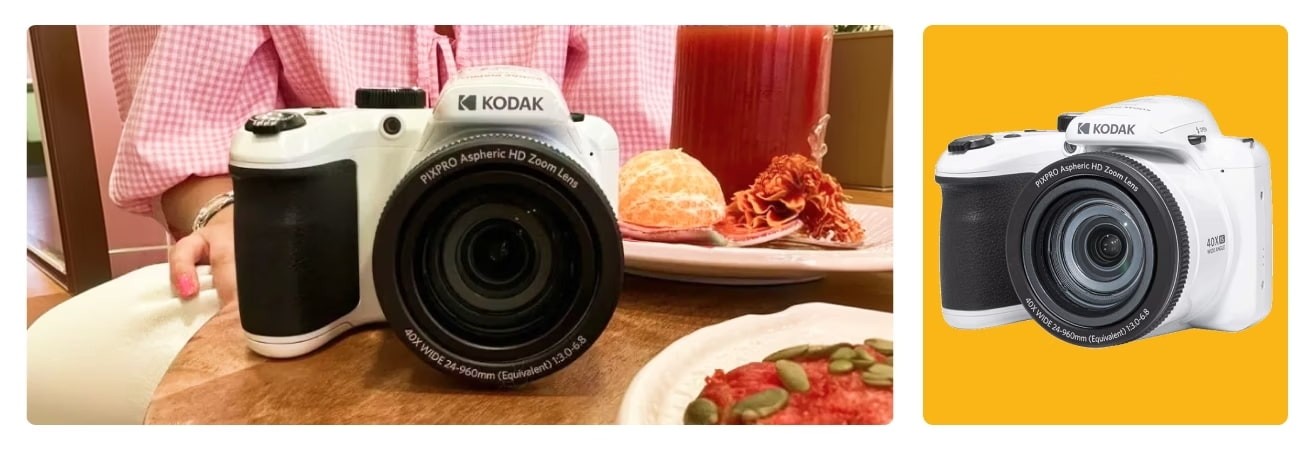
Bridge cameras: these combine the simplicity of compact cameras with more advanced features. Their powerful zoom allows them to cover a wide variety of scenes. The Kodak PixPro AZ528, for example, offers great versatility for keen amateurs who don't want to be weighed down by interchangeable lenses.
SLR cameras: designed for experienced users or professionals, they allow total control over settings. The optical viewfinder and various lenses offer great creative freedom.
Hybrid cameras: more compact than SLRs, but just as powerful. They are perfect for photographers who want to progress and vary their practices without sacrificing quality.
Let's take a closer look at the different techniques below.
What is the difference between an SLR and a mirrorless camera?
The main difference lies in the internal construction. An SLR works with a mechanical mirror and an optical viewfinder. A mirrorless camera, on the other hand, uses an electronic viewfinder or screen, without a mirror system. This makes mirrorless cameras lighter, quieter and often faster for certain functions such as focusing.
In terms of use, SLRs are still popular for their autonomy and robustness, particularly for event photography or studio work. Conversely, mirrorless cameras appeal to content creators, videographers and street photographers. Those who are looking for a good balance between image quality, discretion and responsiveness.
What is the difference between a bridge camera and a hybrid camera?
A bridge camera is a fixed-lens camera, often with a very powerful zoom lens, but one that cannot be changed. It is designed for those who want a versatile tool without having to change lenses. However, it offers less creative freedom.
A hybrid camera allows you to change lenses depending on the scene.
Wide angle for landscapes, telephoto for sports, bright lenses for portraits. It gives you more control over manual settings, depth of field and optical quality. It's a real gateway to more advanced photography.
Why choose a mirrorless camera?
Mirrorless cameras are attracting more and more photographers, and it's no coincidence. They combine the best of both worlds: the image quality of an SLR and the compactness of a lighter camera. This makes them an excellent choice for those who want to upgrade without weighing down their camera bag.
Another advantage is the ability to interchange lenses. This allows you to adapt your equipment to each situation: portraits, landscapes, interiors, sports, etc. This flexibility offers real room for improvement. And if you like to travel light, you'll also find compact hybrid lenses that are easy to carry.
Should a beginner choose a hybrid camera?
Hybrid cameras may be appealing for their performance, but they're not necessarily the best choice if you're completely new to photography. These cameras are often more expensive, especially when you add in the cost of compatible lenses. The budget can quickly add up, even with a basic setup.
In addition to the cost, some hybrid models take a little time to get used to. The ergonomics, settings, and battery life may not be suitable for those who simply want to learn the basics or progress at a leisurely pace.
For those taking their first steps in photography, a compact or a Kodak bridge camera is often simpler and more economical. These are versatile, easy-to-use cameras that are perfect for learning how to frame, compose and have fun without pressure. And they already offer great image quality, suitable for most everyday uses.
How to choose a hybrid camera according to your needs?
Once you understand what a hybrid camera is and how it differs, it's time to move on to the practical stage: choosing one. Whether you're an amateur photographer, a regular traveller or a content creator, some criteria will carry more weight than others. Here's how to make the right purchase.
How to choose a mirrorless camera?
The first criterion to consider is the size of the sensor. Most mirrorless cameras are equipped with APS-C or Micro 4/3 sensors. An APS-C sensor will offer better management of natural or indoor light and background blur. Perfect for portraits or low-light scenes. The more compact Micro 4/3 allows you to lighten your equipment while maintaining good image quality.
Next, look at compatibility with camera lenses. Some hybrids work with proprietary mounts, while others are more open. Also check whether stabilisation is built into the body or the lenses.
Finally, practical aspects make a real difference in use. Autofocus responsiveness, menu ergonomics, battery life. Choosing a hybrid also means thinking about your everyday comfort.
Which profile for which mirrorless camera?
Each photographer's profile will have different needs. Here are a few concrete examples to help you see more clearly.
Creative amateurs will be looking for a versatile mirrorless camera with an APS-C sensor. With a tilting screen to vary the viewing angles and a Wi-Fi connection to easily transfer images. This type of camera allows you to progress without changing equipment in the early years.
The traveller will favour lightness, quick start-up and robust construction. A weather-sealed body and a compact, bright lens are real allies for outdoor photo adventures.
The vlogger or content creator will need responsive autofocus, 4K video quality, a tilt-up screen and a microphone input. These features allow you to produce clear, well-framed videos with good sound quality, without the need for heavy additional equipment.
What to look for before buying a mirrorless camera?
A good mirrorless camera is not just a body. It's a complete system. Before you take the plunge, check whether the range of lenses on offer is varied enough for your future projects. A camera may be good today, but it may be limited tomorrow if the range of lenses is too restricted.
The reliability of the brand, the quality of after-sales service and the availability of accessories are also points that should not be overlooked. You will be handling your camera often, sometimes in less than ideal conditions. It is better to choose a sturdy model with good support.
Hybrid camera: a modern option for developing your photography skills
Hybrid cameras offer an attractive combination of compactness, image quality and flexibility thanks to their interchangeable lenses.
They are versatile tools that can evolve with your photography skills, whether you are looking for creativity, lightness when travelling or a more professional look without technical complexity.
Before making your choice, take the time to identify your real needs. A good camera is not necessarily the most expensive or the most sophisticated, but the one that suits your way of photographing.