


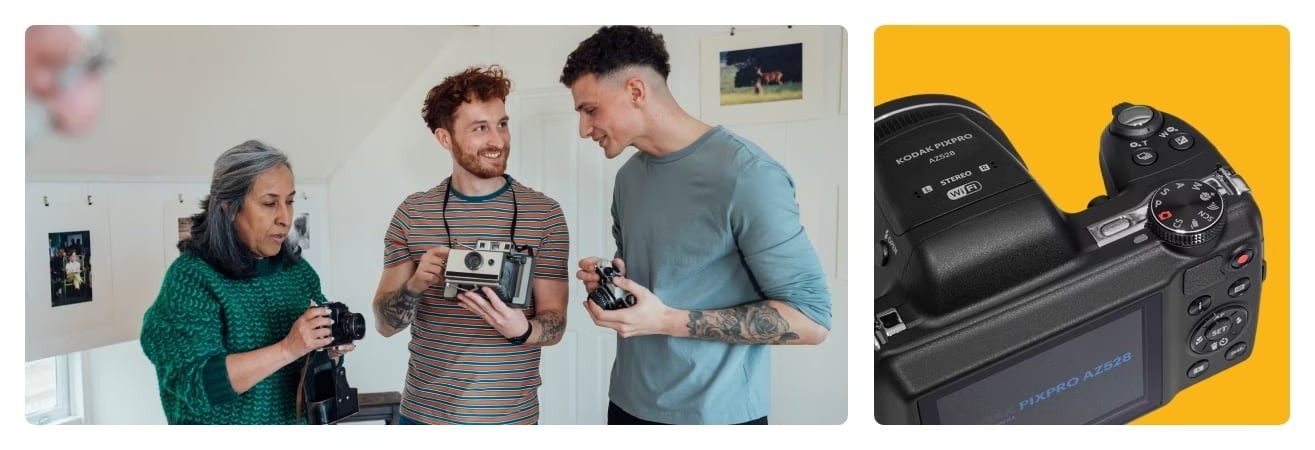
Aperture, shutter speed and ISO: the magic trio of photography
In photography, everything starts with light. It shapes the image. If there is too little, the scene appears dull. If there is too much, the details disappear in a blinding white. To capture it well and take great photos, you need to understand three essential settings: aperture, shutter speed and ISO sensitivity.
The so-called exposure triangle isn't just a technical matter. It's the foundation that allows every photographer, whether beginner or experienced, to give their images style. When balanced correctly, these three settings can transform an ordinary photo into a memorable keepsake. They influence not only the light, but also the blur, movement and atmosphere.
So, are you ready to master this magical trio? Follow this guide to understand how each element of the triangle helps you better capture what you see.
Exposure: how aperture, shutter speed and ISO interact
Exposure is the total amount of light that hits your camera's sensor (or film in film cameras) to create an image. A well-exposed photo is neither too dark nor too light. Bright areas and shadows are well balanced and details remain visible.
To understand this better, imagine that your camera is a bucket and the light is water. The goal is to fill the bucket with just the right amount. The three settings of the exposure triangle act a bit like the parameters for filling the bucket:
Aperture is the size of the tap. The larger it is, the faster and in greater quantity the water (light) enters.
Shutter speed is the amount of time the tap stays open. The longer it stays open, the more the bucket fills up.
ISO represents the bucket's ability to collect water. A very sensitive bucket (high ISO) fills up faster, but the water may be less ‘clean.’ In photography, this means more digital noise.
We refer to this as the exposure triangle because these three settings work together. Changing one affects the balance of the other two. For example, if you open the aperture wider, you may need to reduce the shutter speed or lower the ISO to keep the image balanced.
Understanding this mechanism lays the foundation for successful photography.
Zoom in on each element of the trio: their role and their impact on your images
Each of the pillars of the exposure triangle has its own ‘personality,’ influencing not only the brightness, but also key artistic aspects of your photo, such as sharpness and the perception of movement.
Aperture (f/)
Aperture is the size of the ‘hole’ in the lens that opens to let light pass through to the sensor. It is measured by a number preceded by an ‘f/’ (such as f/2.8 or f/11).
The smaller the number, the larger the aperture and the more light enters. Conversely, a high number corresponds to a small aperture, which lets in less light.
But aperture doesn't just affect brightness. It also influences another essential element: depth of field, which is the area of sharpness in your image, from the foreground to the background.
A large aperture (small f-number, such as f/1.8 or f/2.8) lets in a lot of light and produces a nice blur behind the subject. This is called bokeh and is often used for portraits. It allows you to highlight a face while softening the background.
Conversely, a small aperture (large f-number, such as f/8 or f/16) reduces the amount of light but extends the area of sharpness. This is perfect for landscapes or scenes where you want everything from the grass in the foreground to the mountains in the background to be in focus.
Shutter speed
Shutter speed, or exposure time, refers to the amount of time the shutter remains open to allow light to reach the sensor. It is measured in seconds or fractions of a second (such as 1/1000s, 1/250s or 1s).
This setting has two essential roles. It controls the amount of light captured (the longer the time, the more light enters) and it influences how movement is rendered in the image.
A fast speed, such as 1/1000s or 1/500s, freezes movement. It is ideal for capturing a bird in flight, an athlete in action or any fast-moving subject. This will give you a sharp, blur-free image.
Conversely, a slow shutter speed, such as 1/4s, 1s or even 30s, lets in more light and allows you to play with blur. This creates striking visual effects: waterfall mist, streaks of light from car headlights at night, etc. These effects tell a story beyond a single moment and add style to your photos.
But the longer the exposure, the more stable the camera needs to be. Without a tripod, even the slightest movement can blur the image. And if the subject moves, the blur will be visible in the image. Shutter speed is therefore a balancing act between light, sharpness and motion blur.
ISO sensitivity
ISO, which stands for ‘International Organization for Standardisation’, indicates the sensitivity of your camera's sensor (or film for film cameras) to light.
Simply put, the higher the ISO value, the more sensitive your sensor becomes. This allows you to take brighter pictures when there is not enough ambient light. This is a valuable setting in many situations, from bright sunlight to a dimly lit room.
But this sensitivity has a downside: the higher the ISO, the more digital noise may appear in the image. This noise takes the form of small dots or grainy areas, especially in dark areas. It can affect sharpness and overall quality. That's why, ideally, you want to keep the ISO as low as possible while still getting the correct exposure. Low values such as 100 or 200 will ensure clean, sharp images.
So when should you really increase it? Mainly when the light is too low. If you're shooting indoors without a flash, at sunset or at night, and you can't compensate with aperture or shutter speed, you'll need to increase the ISO to 800, 1600 or higher to avoid a too dark photo.
Another case is when you want to freeze fast action. If you need to use a very fast shutter speed (for example, in sports or wildlife photography), a higher ISO will help you maintain good exposure, especially if the aperture is already at its maximum.
Some photographers like grain for its vintage look. But most prefer to add it later, using software such as Lightroom or Photoshop. This allows you to maintain control over the final result without degrading the basic quality of the image.
There are several ways to limit the negative effects of too high an ISO.
First, use good editing software. Lightroom, for example, offers very effective noise reduction features, especially if you are working with RAW files.
Next, consider investing in a fast lens. A large aperture, such as f/1.8 or f/2.8, lets in more light. This allows you to keep the ISO low, even in low light. It's a real bonus for improving your images, especially indoors.
Finally, take the time to get to know the limits of your camera. Not all cameras react the same way to noise.
Test it in different lighting conditions, gradually increasing the ISO to see how far you can go without degrading your images. This will allow you to anticipate and adjust your settings with confidence. For example, our Kodak AZ528 bridge camera model allows ISO settings from 100 to 3200.
Practical tips for setting your exposure triangle
There is no single recipe, it all depends on the light, the subject and what you want to convey with your image. It's a subtle interplay between aperture, shutter speed and ISO. Here are a few pointers to get you started and take great photos, whatever the scene!
Photographing a portrait
For a bright and soft portrait, the idea is to highlight the subject with a nicely blurred background. A wide aperture such as f/2.8 or f/4 creates this artistic blur that separates the face from the background. You need to use a fast enough shutter speed, at least 1/125s, to avoid motion blur, especially if you are holding the camera in your hand. As for ISO, it's best to keep it low, around 100 or 200, for a sharp, noise-free image.
Photographing movement
If you're photographing fast-moving subjects, such as a child running, a bird in flight or a player in action, your priority is speed. You need to freeze the movement. A fast shutter speed, such as 1/1000s, is essential. To avoid losing too much light, open the lens to f/5.6, or even wider if possible. And don't hesitate to increase the ISO, sometimes up to 800, 1600 or more, depending on the ambient light. It's better to have a little grain than to miss the decisive moment.
Photographing a landscape
When it comes to landscapes, everything changes. This time, it's not the subject you want to isolate, but the entire scene you want to be in focus, from the foreground to the horizon. A small aperture, such as f/8 or f/11, will give you a nice depth of field. If there is enough light, a shutter speed of 1/125s may be sufficient. Otherwise, a tripod will be your best friend for keeping the image sharp, even at slower speeds. And here again, keep the ISO as low as possible to avoid noise.
Night photography
Finally, for night or low-light shots, the challenge is to balance light and sharpness. Open up as much as possible, f/2.8 or f/3.5 depending on your lens, to capture as much light as possible. The shutter speed will need to be slow, sometimes up to several seconds, so a tripod is essential. Increase the ISO if necessary, sometimes up to 3200 or higher. A little grain is better than a photo that is too dark. It is in these conditions that the exposure triangle comes into its own, and every choice becomes crucial.
Feel free to check out our comparison article on Kodak bridge cameras in the AZ range to help you make the best choice.
Additional tips for taking great photos
Try it for yourself
Reading about photography is great, but nothing beats practice. Get out there, try different conditions and experiment. The more you try, the more you'll learn to instinctively know which settings to choose for different types of light. The more you shoot, the more natural it will become. Set your camera correctly
If your camera allows it, activate automatic ISO, especially if you are just starting out. This is a valuable aid in avoiding missed shots when the light changes quickly. But remember to set a limit to prevent the camera from going too high and adding unnecessary grain.
In low light, if possible, add a light source. A well-balanced flash or a simple lamp can make all the difference, limiting the use of high ISO settings and maintaining good image quality.
ISO, aperture and shutter speed are more than just settings: they are your tools of expression. With them, you learn to manage light like a painter manages their colours. Whatever the time of day or the scene, you can adapt your shot to suit your intention.
Over time, this trio will no longer be a headache but a reflex. Taking great photos will become the norm. You'll go from capturing a moment to creating an image. So grab your Kodak camera and set out to conquer the light. Your eyes have stories to tell.