


Camera or smartphone camera : a comparison !
Smartphones have revolutionised how we take photos, making photography more accessible than ever. Fast, connected and always available, they have real advantages on their side.
But with smartphones taking the world by storm, do traditional cameras still have a place? Between image quality, technical precision and creative freedom, they still have some strong arguments in their favour.
In this article, we offer a clear comparison between smartphones and cameras. The aim is to understand their differences and how they complement each other. But also to discover why certain accessories can transform your everyday photography experience.
Has the smartphone replaced the camera?
Taking a photo today is as easy as pie with a smartphone. But is the practicality of the smartphone enough to erase the advantages of dedicated cameras? The comparison is worth making.
The smartphone has become a universal capture tool. However, certain uses still reveal the value of a camera. Especially when you're looking for more than just a souvenir.
How does a smartphone photo compare to a camera photo?
On paper, smartphones offer a lot of promise. High definition, intelligent processing, built-in creative effects. However, when you take a closer look, they are still limited by the size of their sensor, the power of their zoom and their automatic light management.
Where a dedicated camera makes the difference is in its control of depth of field and the quality of its sensor. And above all in its optical zoom. Unlike the digital zoom on smartphones, which degrades the image at every level, an optical zoom preserves sharpness. Even at long distances. This allows you to frame your shot with precision without sacrificing detail.
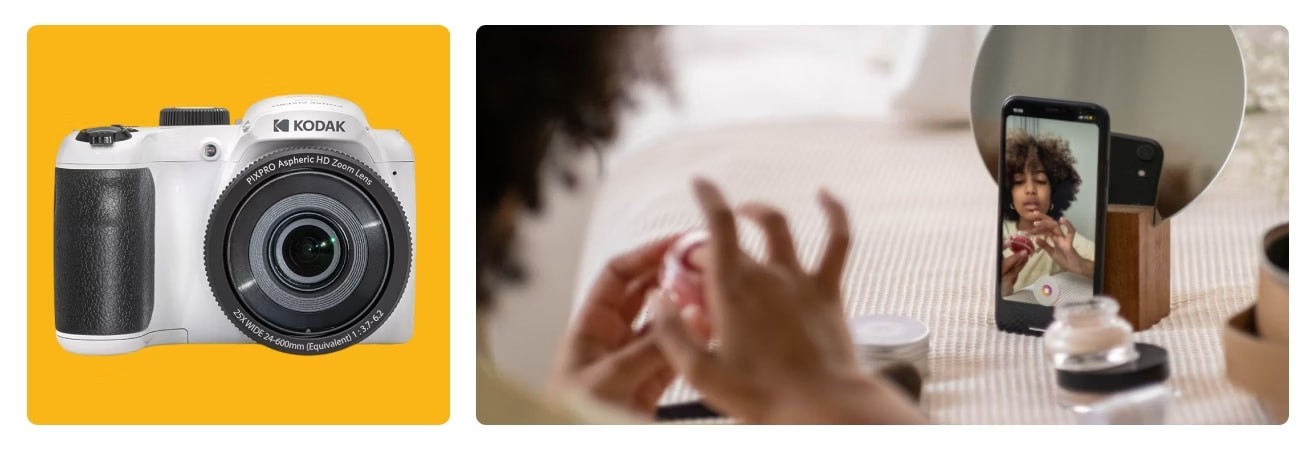
Bridge cameras, such as those offered by Kodak, are a good example of this technical performance. The powerful zoom, good grip and ability to adjust settings manually offer real creative freedom. It is a hybrid format that is easy to use but capable of producing high-quality images, even in complex conditions.
Is a camera still necessary in the age of the smartphone?
The usefulness of a camera cannot be measured solely by how often it is used. We must also consider those moments when we want to step outside the automatic settings of a smartphone. When we want to take the time to compose a real photo.
When travelling, for example, having a dedicated camera allows us to take more suitable equipment with us. For changing light, landscapes or night scenes, for example. At a wedding or other significant event, it is also a way to obtain more expressive shots. With better reproduction of colours, textures, or faces.
Fans of portraits, animal photography, or artistic creations will also find what they are looking for with a camera. It offers a more natural, less filtered rendering and leaves room for the photographer's intention.
The article Do we still need a camera in the age of smartphones? addresses this fundamental question with concrete examples, particularly in the school and personal contexts.
What are the real advantages of cameras?
While smartphones are appealing for their practicality, cameras still have serious advantages. Image quality, creative freedom, autonomy... these are all criteria that make a difference in many situations.
It's not just a question of technology. It's also a different way of taking photos, of slowing down the action, of choosing a frame, of thinking about the light. And this starts with the most affordable models.
The advantages of compact and instant cameras
For those who want a simple, lightweight and hassle-free camera, the compact remains a safe bet. Their size means you can take them anywhere without sacrificing image quality. Unlike smartphones, they feature a real optical zoom, which preserves sharpness even in close-up mode. This is ideal for photographing a landscape, a monument or a street scene without distortion.
In addition, instant cameras offer a completely different experience. Here, there is no screen and no editing. The photo appears in your hands in a matter of seconds. It's a simple, almost playful gesture that appeals to children and adults alike. Perfect for creating instant memories at a birthday party, wedding or trip. It's a completely different approach to the smartphone, where the photo comes to life and doesn't get lost in a digital gallery.
Kodak offers several models that combine this spontaneity with good print quality. It's a different way of experiencing photography, where every shot counts and you take the time to get it right.
The comeback of disposable and analogue cameras
Far from being outdated, analogue cameras are attracting more and more enthusiasts. This return to film responds to a desire to break away from digital logic and rediscover a certain grain. With a particular aesthetic and sometimes even the pleasure of surprise when the film is developed. It's a return to vintage photography, which only certain cameras allow.
Photographing with film means learning to compose with light, to anticipate each shot, to trust your eye more than an algorithm. It is also a way to slow down and focus on the moment.
On another note, disposable cameras are still very relevant. You can slip them into your suitcase for a weekend away, hand them out to guests at an event, or use them to capture moments without stress. Their simplicity is appealing and their output gives the images a special charm, with a touch of spontaneity that is often missing from overly polished shots. This is a playful aspect that is unique to this type of camera.
The Kodak range offers solid options in both categories, with models designed for amateurs and curious minds alike. These cameras are built to last, or to be forgotten... while capturing the essentials.
The technical advantages of cameras
What sets a camera apart is first and foremost its ability to manage remote shooting. Thanks to the optical zoom, the image remains sharp and detailed, even from a distance. This allows you to capture a subject without moving, while maintaining a natural look, without artefacts or degradation.
Another strong point of the camera is its light management, especially in difficult conditions. A smartphone relies on software processing to compensate for the lack of light. A camera, on the other hand, relies on a larger and more sensitive sensor. This makes all the difference for indoor, twilight or night-time shots.
Finally, battery life is not to be overlooked. A camera is designed to last several hours without recharging, and you only need to change the battery to get going again. When travelling, reporting or covering an event, this is a real guarantee of peace of mind.
To ensure you never miss an important photo, Kodak offers spare batteries suitable for its models. Convenient to carry, they allow you to extend your photo sessions without stress.
What are the essential photography accessories?
A good camera often comes with discreet but useful accessories. They extend its use, protect it and provide real peace of mind, especially when travelling or at events.
Whereas smartphones are often limited to a case or cover, cameras allow for truly tailor-made equipment, designed to keep up with the photographer's pace. These accessories may seem secondary at first, but they play a real role in shooting comfort and equipment durability.
How can you protect your camera?
When you go on holiday, on a reporting assignment or on a photo shoot, you don't want to worry about your equipment. A well-protected, well-organised and easy-to-carry camera quickly becomes a trusted ally.
Kodak protective cases effectively meet this need. They are designed to fit every type of camera (compact, bridge, instant, etc.). They protect your equipment from shocks, dust and moisture. Some even have practical compartments for storing a spare battery or memory card.
This level of protection is difficult to find for smartphones, where accessories are less specialised. In photography, being able to carry your camera without fear, while keeping everything within reach, clearly makes a difference. It's a detail that improves mobility and responsiveness in all situations.
Photo storage
In photography, storage is also an important factor. With a camera, you have a dedicated memory card. It is independent of your personal files, applications or messages. This frees up space and avoids unpleasant surprises.
You can also choose the image format that best suits your needs. JPEG for lightweight management, RAW for maximum quality in post-production. The camera offers flexibility that smartphones do not always provide.
File classification is also simpler. You can organise your photos by folder, date, or theme, without relying on an application or automated system.
For this, Kodak memory cards are a reliable solution. Large capacity, fast transfer, and extensive compatibility. They accompany amateur and passionate photographers alike in all their projects.
How much does it cost to get started in photography?
It is often mistakenly believed that getting started in photography requires a large budget. However, with smartphones constantly moving upmarket, it is not uncommon to see models costing over £1,000. Sometimes much more if you want to enjoy a high-performance sensor and some advanced photo options.
Conversely, it is entirely possible to get started in photography with a dedicated camera for less than £100. At Kodak, certain compact, instant or disposable models allow you to discover photography without breaking the bank. All while offering a true photo rendering, more natural and faithful than a compressed snapshot on a mobile phone.
It's also a good way to learn how to frame a shot, observe the light and take your time when pressing the shutter button. The experience is different, more relaxed and often more rewarding. For personal, family or even school use, these cameras are a simple, reliable and economical gateway to the world of photography.
And unlike smartphones, where the camera is integrated into an entire ecosystem, here the investment is clear. You are buying a tool designed solely for creating images, with consistent quality and real durability.
Camera or smartphone camera: choose the right one for your needs
Smartphones have made photography accessible to everyone, everywhere and at any time. But as soon as you want to go further, to improve quality, creativity or comfort, the camera regains its rightful place.
Compact, bridge, instant or even disposable, each format has its advantages. And with the right accessories, the experience becomes even simpler, smoother and more controlled. It's not about pitting two worlds against each other, but about choosing the right tool for the moment.
At Kodak, the diversity of our ranges allows everyone to find their balance, whether it's to immortalise a trip, capture a portrait or create memories to share.