


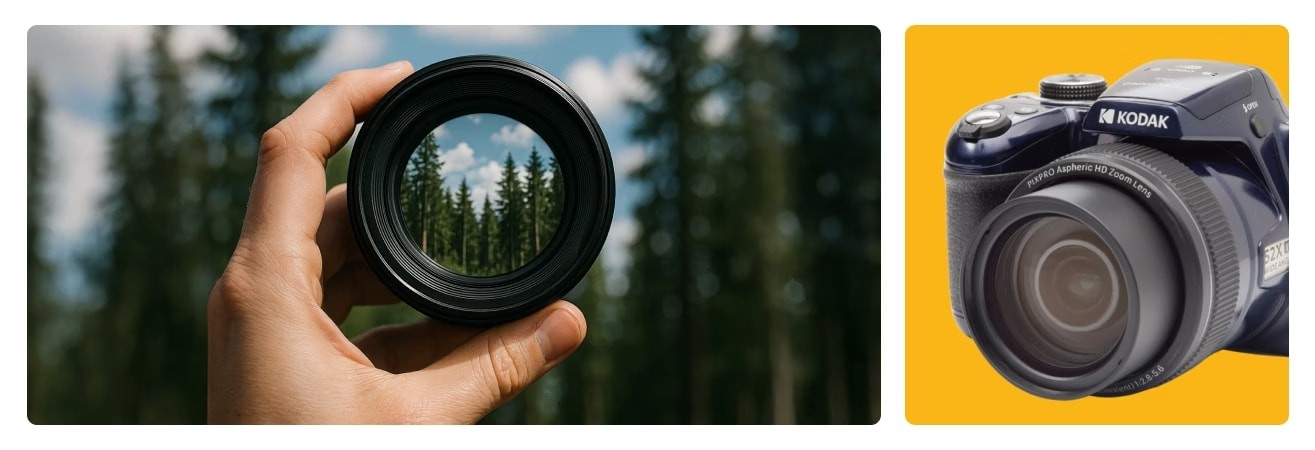
Camera lenses : what you need to know to choose the right one !
Whether you're just starting out in photography or looking to refine your style, you're going to ask yourself this question. How do you choose the right camera lens? Behind this question lies one of the most important elements of your equipment. The lens literally shapes the image. It determines the framing, depth, sharpness and light. In short, it has everything to do with the final result.
But between focal lengths, apertures, zooms and compatibility, it's easy to feel lost. However, with a few simple guidelines, you can quickly understand what distinguishes a good lens from a less suitable choice. And above all, learn how to choose according to your needs: portrait, landscape, travel, sport... each practice has its own requirements.
In this article, we'll guide you step by step to help you better understand the role of camera lenses, learn how to differentiate between them, and, above all, make the right choice.
What is a camera lens used for?
Behind every beautiful photo is a well-chosen lens. Although we often talk about the camera body, it is the lens that plays a central role in image quality. It acts as the eye of the camera. It captures light, shapes the frame, and makes an image soft or ultra-precise, bright or contrasted.
How can you recognise a good camera lens?
Three criteria are essential to understanding what a lens can offer you. First of all, the focal length. This influences the distance and angle of view. The aperture, which determines the brightness and depth of field. And finally, the optical quality, often referred to as ‘sharpness’, which determines the clarity and precision of the details. In addition to these technical elements, there are practical considerations such as weight, compactness, stabilisation and ease of use.
Even before you think about settings, it is the lens that determines how you take your photographs. Knowing what it can do is the first step in developing your eye.
What are the different types of camera lenses?
There is a wide variety of lenses, each with its own specific uses. The most classic are fixed focal length lenses, such as 35 mm or 50 mm. They do not zoom, but offer high optical quality. They are often chosen for portrait or street photography.
Zoom lenses allow you to switch from a wide angle to a tight frame without changing lenses. They are very practical and adapt to a variety of situations, such as travel or sports scenes. Among them are wide-angle lenses (for landscapes or architecture), telephoto lenses (for capturing distant subjects without moving) and macro lenses, which reveal the finest details of a very close object.
How do you choose the right camera lens for your needs?
Not all photographers are looking for the same thing. Some want to capture the emotions on a face, while others prefer to immortalise a landscape or follow the action in motion. So there is no such thing as a universal lens. What matters is identifying your desires and your shooting habits.
Choosing the right lens means thinking about how you will use it, not just its technical specifications. It also means being willing to compromise. A very powerful zoom lens may be less bright, while a very precise lens may lack versatility. The key is to take it step by step, equipping yourself with lenses that are suited to your style of photography.
35 mm or 50 mm lens?
This is a question many beginners ask themselves. The 35 mm and 50 mm are two fixed focal lengths that are highly appreciated for their simplicity and image quality. The 50 mm is close to the human eye, making it a natural choice for portraits or everyday photography. It offers a nice background blur and beautiful brightness, ideal for isolating a subject.
The 35 mm, on the other hand, offers a slightly wider angle. It allows you to capture more context while maintaining a nice proximity to the scene. It is often preferred for street photography, scenes of everyday life, or more spontaneous atmospheres.
If you're hesitating between the two, a camera like the Kodak PixPro AZ401 might be of interest. Its 40x optical zoom, equivalent to a focal range of 24 to 600 mm, allows you to test the results of a 35, a 50 and much more. It's a good way to experiment with different focal lengths without having to invest in multiple lenses. Lightweight and affordable, it's a great way to get started and figure out what you like best.
Which camera lenses are essential for travelling?
When travelling, you often don't have the time or space to change lenses. The ideal solution is to equip yourself with a versatile lens that can adapt to any situation. Two types of focal lengths are particularly useful for this. A wide angle for landscapes or architecture and a telephoto lens for capturing distant details or taking portraits without getting too close.
An all-in-one zoom lens generally covers this range. It's a convenient choice, especially if you're travelling light or want to remain discreet.
The Kodak PixPro AZ405, with its 40x optical zoom, fits perfectly into this category. It switches from a 24 mm wide angle to a 960 mm telephoto lens in an instant. Its optical stabilisation enhances image sharpness, even when shooting handheld, and the 360° panorama function allows you to capture spectacular scenes effortlessly. This type of camera is a true travel companion, whether you want to capture a city, a mountain peak or a moment in time.
Checking the compatibility and performance of a camera lens
Choosing a lens is not just a matter of comparing focal lengths or looking at the price. A good lens is also one that is compatible with your camera and capable of getting the best out of it. To do this, several technical criteria must be taken into account. The mount, the type of sensor, the stabilisation system, and even the weight. These elements directly influence image quality and ease of use.
In photography, technique is at the service of practice. It is therefore important to understand these concepts, without getting lost in the details.
How do I know which lens is right for my camera?
The first thing to check is the mount. This is the connection between the camera body and the lens. Each brand has its own standards, which are often incompatible with each other. If you use an SLR or hybrid camera, you will need to make sure that the lens you choose is compatible with your camera body. Alternatively, you will need to ensure that a reliable adapter is available.
Another important point is the sensor format. A lens designed for a full-frame sensor will not produce the same results on an APS-C sensor. You should also consider the weight of the lens, especially if you plan to use it for long periods of time or when travelling.
Finally, optical stabilisation can make a big difference. It compensates for small hand movements and produces sharper images, even with a high zoom.
For those who want to avoid the technical constraints of interchangeable lenses, bridge cameras are a simple and effective solution. The Kodak PixPro AZ425, for example, features a stabilised lens with 42x optical zoom, covering a very wide focal range. It is an all-in-one camera that does not require any lens changes. It is suitable for those who want high-performance equipment without worrying about compatibility.
What are the characteristics of a good lens?
A good lens is, above all, a lens that produces a sharp image with no visible flaws. Sharpness, or the ability to render details, is a good indicator of quality. It varies depending on the aperture used, the focal length, and the optical construction.
Distortion is another factor to watch out for, especially at extreme focal lengths. Some lenses slightly distort the image, especially at wide angles. A good lens can correct or limit these effects.
The aperture plays an important role in brightness and depth of field. A large aperture (e.g. f/2.8) allows you to shoot in darker conditions or create a natural bokeh, the background blur that is so popular in portrait photography. If you want to learn more about this topic, we have a comprehensive article: Understanding aperture, shutter speed and ISO: the magic trio for successful photography
Finally, stabilisation, focus speed, resistance to external conditions and weight are also criteria to consider, depending on how you intend to use the camera.
The interchangeable lenses on SLR and hybrid cameras often allow for more freedom, but also require more technical skill. Bridge cameras, such as those in the Kodak PixPro range, come with high-quality lenses built in. They feature stabilisation, wide angle and powerful zoom. An ideal solution for those who want to take beautiful photos without adding to their collection of accessories.
Why buy a bridge camera?
When you're new to photography or looking to improve your skills without complicating your life, choosing the right equipment can quickly become a hindrance. Some people give up before they even start. Between lenses that need to be purchased separately, compatibility issues and sometimes technical settings, it can be complicated. This is where bridge cameras come into their own.
They combine a powerful, versatile and stabilised lens capable of covering a wide variety of situations in a single body. You can switch from landscapes to portraits, from close-up subjects to distant scenes, without changing your equipment. It's an ideal gateway to creative photography, without the constraints of professional equipment.
Can you learn photography with a bridge camera?
Learning photography is above all about practice. And to practise, you need a camera that makes you want to experiment, without frustration. Bridge cameras offer this freedom. Their built-in zoom covers a wide focal range, allowing you to try out different framing styles without having to invest in multiple lenses.
It's also a way to focus on the essentials: light, composition, and the moment. Without being distracted by complex technical choices. Operation is often guided. The menus are simple, and many models offer intelligent automatic modes. All while leaving room for manual adjustments when you want to go further.
The Kodak PixPro AZ528 is a perfect example of this concept. With its 52x optical zoom, it offers a very wide focal range, from wide angle to long-range telephoto. It also features optical stabilisation, 6 frames per second burst shooting and a 3-inch screen. This is quite convenient for framing or reviewing your images. It even includes Wi-Fi connectivity, which is handy for quickly transferring your photos to a smartphone.
Choosing a bridge camera like this one means investing in a complete camera that will evolve with you. It is designed for those who want to progress at their own pace without having to manage a whole range of lenses.
Choosing the right camera lens for your needs
There is no such thing as an ideal lens, but there are lenses suited to every use. By observing your shooting habits, you will know what you need. For some, a bright 50 mm lens will do the trick. For others, a powerful, stabilised zoom lens will be more reassuring. There are no hard and fast rules, only choices to be made according to your desires, your constraints and your way of photographing.
Bridge cameras, such as those in the Kodak PixPro range, may also be suitable. They have the advantage of combining simplicity and versatility. They offer a great alternative for those who want to go further without getting lost in the technical details. With a built-in zoom, good image quality and progressive settings, they allow you to have fun while learning.
Before thinking about the equipment, you need to think about the image you want to capture. And that's a matter of perspective.