


Teenage cameras : How to choose the right model ?
More and more young teenagers are developing a genuine interest in photography. Some simply want to capture memories of holidays or outings with friends. Others are discovering a passion for creating images or dream of posting their best shots on social media.
Giving a teenager a camera can be a great idea. But you still need to know which one to choose. Today, there is a wide variety of models available, from simple compact cameras to instant cameras and more advanced models. Each has its advantages, depending on the age, skill level and desires of the person who will be using it.
This article will help you see things more clearly. You'll find practical advice on how to choose the right camera for teenagers, as well as examples tailored to each profile and answers to the most frequently asked questions from parents and young people alike.
What criteria should you consider when choosing a camera?
With so many different models available, it's not always easy to know what to look for first. To support a teenager in their first steps in photography, you need to focus on certain important criteria. It's not necessarily about aiming for performance at all costs, but rather finding the right balance between ease of use, image quality and enjoyment.
What is ergonomics in a camera?
This point is often underestimated, yet it is essential. A camera that is too bulky or too thin can quickly discourage a teenager. It needs to fit comfortably in the hand, be well balanced, and have buttons that fall naturally under the fingers.
A good camera for beginners is also one that you're not afraid to carry around. It should be light enough to take on an outing with friends, a school trip or a weekend away with the family. The position of the screen, the readability of the menus and the presence of a viewfinder can also influence ease of use.
A teenager who feels comfortable with their camera will enjoy using it more and progress more quickly.
What is a simple-to-use camera?
A well-designed camera for a teenager is one that anticipates their needs. The menus should be clear, the settings accessible, and the useful functions easy to activate. Far from the technical approach of SLR cameras, a good entry-level model should offer intelligent automatic modes that can detect scenes, adjust the light, or stabilise the image.
It is also useful for the camera to offer shortcuts, such as a video button or a quick access button to the gallery. This saves time and keeps photography intuitive.
This ease of use plays a fairly important role in the confidence a young person can have in their camera, especially if they are just starting out.
Zoom, image quality and video
Even if performance is not the top priority, image quality is still important to avoid disappointing results. For teenage use, a 12 to 16 megapixel sensor is more than enough. It allows you to capture sharp photos that can be viewed on screen, printed or shared. A 3x to 5x optical zoom offers enough latitude to vary the framing without losing sharpness. Even a 4x digital zoom is perfectly suitable for a beginner.
When it comes to video, HD or Full HD is now an accessible standard. This is perfect for filming scenes with friends or making short videos for social media or school projects.
What is the best first camera for a beginner?
There is no universal model. The best first camera for a beginner is one that suits their actual needs without overwhelming them. It is neither the most expensive nor the one with the most features.
A good choice is a camera that makes you want to practise, arouses curiosity and leaves room for improvement. It should be easy to use from the outset, while allowing you to discover new options little by little.
In short, it is better to choose a simple camera that is enjoyable to use and versatile enough to accompany teenagers in their first forays into photography. However, in the rest of this article, we will still review several interesting options. Each has its own advantages to suit the desires and uses of young people, whether they are beginners or already a little more comfortable with photography.
Which camera for a teenager, depending on their age and skill level?
As you can see, choosing a camera for a teenager is not just a question of price. Above all, it must be suited to their age, learning style and relationship with images. A model that is too complex can quickly become discouraging. A camera that is too basic may not keep pace with their evolving interests. The right balance is often found in the camera's ability to support the young person without holding them back or overwhelming them. Here are three common scenarios, with appropriate recommendations.
Which camera is best for a teenager starting out?
When a teenager discovers photography, everything is new to them. Framing, lighting, basic settings. The goal is not to strive for technical perfection, but rather to cultivate a desire to take photos. The camera should be simple, easy to use, and engaging enough to spark curiosity.
An attractive design can also play an important role. At this age, aesthetics often matter as much as performance. A compact camera that is easy to carry and comfortable to use is a good place to start.
The Kodak C1 with its vintage look is the perfect candidate for this mission. It appeals to teenagers looking for originality and is easy to use right out of the box. The swivel screen allows you to vary the angles or take selfies with more freedom. It has a 4x digital zoom, ideal for learning without pressure. It is a camera designed for discovering photography, without getting bogged down in complexity. There are also other very interesting alternatives, which we will detail below.
What camera is best for a 10-year-old?
Around the age of 10, pre-teens begin to take an interest in the tools used by adults. They want to capture their own memories, follow their parents on outings, or simply photograph what they love. They need a camera that is both simple and comprehensive, with real photo functions, without being too technical.
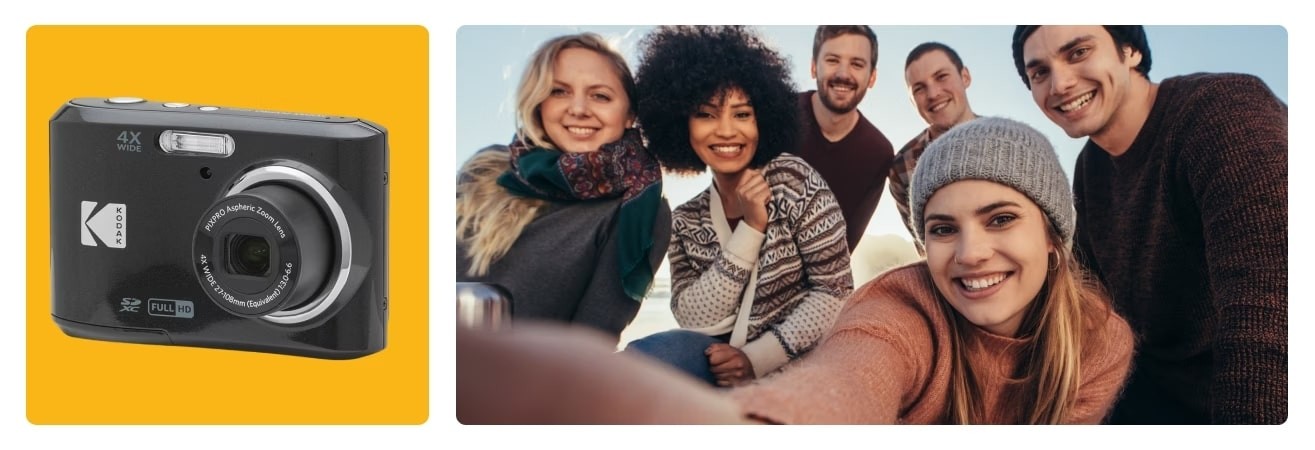
A compact model with optical zoom, a good-quality sensor and a simplified interface is often an excellent compromise. It should be able to accompany a curious youngster without overwhelming them with settings. The Kodak PixPro FZ45 is the ideal compact camera for these budding young photographers.
It has a 4x optical zoom, a 16-megapixel sensor and shoots HD video. Its ergonomics have been designed with beginners in mind, with clear menus and well-balanced automatic functions. It allows pre-teens to have their first experiences with photography in good conditions, without complicated settings. It is similar to the Kodak C1.
Which camera for ages 12 and up?
From the age of 12 onwards, teenagers are often more independent. They go on school trips, travel with family or friends and like to photograph what is going on around them. They may also have a more spontaneous, less cautious approach. The ideal camera is therefore one that is both powerful and durable.
You need a model that can keep up with them everywhere they go. At the beach, in the forest, in the mountains, or even at home. A robust camera that isn't afraid of water or shocks and maintains good image quality.
The Kodak PixPro WPZ2 is the perfect holiday companion, but that's not all: it ticks all the boxes. It is waterproof up to 15 metres, resistant to drops and dust, and has a 16 MP sensor. The interface is easy to use, even for teenagers who don't want to spend time fiddling with settings. It's a camera designed to keep up with everyday life without any fuss, whether at the beach or on a nature outing. The features of this camera make it an excellent, highly versatile camera that is completely connected to the needs of teenagers.
Why do teenagers still choose digital cameras?
While almost all teenagers own a smartphone, it may seem surprising that they would ask for a digital camera. However, this is becoming more and more common because compact cameras have many advantages. Behind this choice is a desire to experiment in a different way, to detach oneself from the constant flow of apps and reconnect with the pleasure of a well-composed image. Let's explore the reasons behind this comeback.
Why use a digital camera rather than a phone?
A smartphone is handy for capturing a moment on the fly, but it has its limitations. The experience of a dedicated camera is very different. First, there are no distractions. No notifications or calls interrupting the shot. The young photographer remains focused on what they are doing.
Second, the optical quality is superior. Even a modest optical zoom allows you to frame the shot without losing sharpness. Light is better managed thanks to a dedicated sensor, resulting in more natural images, even indoors or in backlighting.
Finally, handling a camera adds another dimension to the gesture. You hold it differently. You take more time. It's a more immersive approach, often more rewarding for a teenager who wants to learn.
Why do teenagers use digital cameras?
Teenagers have a strong desire to stand out. Many of them are looking to break away from the uniformity of automatic filters and quick selfies. With a digital camera, they can work on their framing, play with light, or explore more personal worlds. The image quality is also different, much more faithful than smartphones. The image has a particular grain that teenagers are increasingly fond of.
There is also a need to disconnect. Some teenagers even see it as a way to find calm, a way to focus on the moment.
Finally, many want to produce more polished content, whether for a blog, a YouTube channel, or simply for their own enjoyment. The camera then becomes a tool for self-expression in its own right.
Do people still buy digital cameras?
Yes, and in increasing numbers. Digital camera sales are no longer limited to enthusiasts or professionals. Many families now choose to equip their children with a compact and affordable model. This is precisely to avoid premature exposure to phones.
This trend is part of the comeback of the compact digital camera, driven by a desire for simplicity, durability and a direct relationship with the image. This choice is no longer purely technical, but also educational and symbolic.
Which camera is best for teenagers?
There is no single right answer, as it depends on the young person's profile. Some will prefer an instant camera, which prints photos directly. Like the Kodak Mini Shot 2 ERA MS200, which not only takes digital photos but also prints them directly in 2.1 x 3.4 inch format. It's a fun solution, perfect for creations to stick in a travel journal, give to friends or display in your room. It combines instantaneity with the pleasure of the photographic object.
Others will want an advanced compact camera with a few settings and an optical zoom to take things further.
Those who like to be active and enjoy outdoor activities may want to look at the best models of waterproof cameras for aquatic adventures.
Choosing the right camera for a teenager means thinking about how it will be used above all else
Giving a teenager a camera is giving them a tool to explore, create and learn to see the world differently. Whether it's their first encounter with photography, a way to document their holidays or the start of a new passion. The key is to choose a camera that is suited to their age, interests and learning style.
Some will prefer simplicity, while others will want to go a little further. The right camera is one that supports them without holding them back, makes them proud of what they capture, and remains accessible on a daily basis.
Photography can become a real outlet for personal expression during adolescence. And with the right tools, it can also spark a wonderful curiosity about technology or art. The most important thing is to give them the space to experiment at their own pace.