


DSLR Camera : What is it and how do you use it ?
Photography is often about capturing what you see, but also what you feel. For those who want to go beyond simply clicking a smartphone, a DSLR camera opens up a whole new world of possibilities.
Often associated with passionate photographers, it appeals for its level of control, image quality and creative potential. But behind its apparent complexity, the digital SLR camera remains quite accessible to anyone who wants to learn or improve.
Let's take a look at what a DSLR is, who it's for and how to get started.
What is a DSLR camera?
If you're just starting out or have questions about this type of camera, don't worry. DSLR (Digital Single Lens Reflex) cameras are often perceived as complex, but they work on simple principles. You just need to understand them to better appreciate what they have to offer.
What does DSLR mean?
DSLR stands for Digital Single Lens Reflex. The central element of this system is the mirror. When you frame an image through the optical viewfinder, light passes through the lens, is reflected by a mirror towards a prism, and then towards the photographer's eye. This mechanism allows for a very accurate view of reality.
When the picture is taken, the mirror briefly lifts up to allow light to pass through to the digital sensor. It is this technology that has long made SLR cameras a must-have for lovers of beautiful images.
The power of a DSLR camera
An SLR camera allows you to change lenses according to your needs. Wide angle for landscapes, telephoto for wildlife photography, fixed focal length for portraits... Each lens offers a different view of the world. It is this modularity that appeals to many enthusiasts.
The direct optical viewfinder also allows you to anticipate the effects of natural light without having to use a digital screen. This improves responsiveness, especially for action shots or spontaneous scenes.
Differences between DSLR cameras, compact cameras and bridge cameras
Unlike a compact camera, which is designed to be simple and automatic, a DSLR offers more scope for manual adjustment. You have control over the shutter speed, aperture and ISO sensitivity. This allows you to personalise each photo and adapt the settings to the light and subject.
Compared to a bridge camera, an SLR remains more versatile thanks to its interchangeable lenses. But for many users, a good bridge camera can be a great alternative, especially for those who want to avoid constantly changing lenses.
Take the Kodak PixPro AZ401, for example. It offers a 40x optical zoom, good image quality and intuitive handling. It has the look of an SLR, but is lighter, simpler and more accessible. For everyday use, travelling or family events, it's a camera that does the job perfectly.
Why has the DSLR long been the camera of choice for enthusiasts?
Before the advent of hybrid cameras and high-performance smartphones, the DSLR was the go-to choice for anyone wanting to improve their photography skills. It allowed users to control the image at the moment of shooting and develop a real technical approach. As you can imagine, they produced very high-quality images, even in difficult conditions.
Even today, they remain a solid tool for learning photography with precision. And even though other types of cameras have taken over for some users, SLRs continue to appeal to those who want total control and professional results without too much automation.
What are the advantages of a DSLR camera?
DSLRs continue to appeal because they allow you to take your photography to the next level. For enthusiasts and those who want to go beyond automatic modes, it is a comprehensive tool that combines precision and creative freedom.
The image quality of a DSLR camera
The strength of a DSLR camera lies largely in its sensor. Larger than that of a compact camera or smartphone, it captures more light. This increased sensitivity allows you to take photos even when the light is low, while maintaining detail and sharpness.
For example, at an indoor concert or at dawn in the countryside, a DSLR allows you to capture nuances without overusing the flash. Colours remain natural and digital noise is better controlled.
Express your creativity with a DSLR camera
Photographing with a DSLR is like cooking with raw ingredients. You can adjust each setting by hand: aperture, ISO sensitivity, shutter speed, white balance. It takes a little practice, but you'll learn how to shape light, freeze movement or, conversely, play with artistic blur.
This is particularly useful for those who want to improve their skills or simply create photographs that reflect their personality. A portrait taken at the end of the day by a lake, for example, can be transformed by playing with depth of field and colour temperature.
Change lenses to vary your shooting styles
Another major advantage is the ability to change lenses. A wide angle for landscapes, a telephoto lens for wildlife photography, a fixed focal length for portraits... There is a dedicated lens for every use.
This level of customisation makes the DSLR a particularly popular tool for a variety of styles. On a photo safari, for example, it is possible to switch from a wide shot to a close-up of an animal simply by changing lenses.
A simpler alternative to a DSLR camera
For those who want to explore different styles of photography without having to buy multiple lenses, some bridge cameras are the perfect solution.
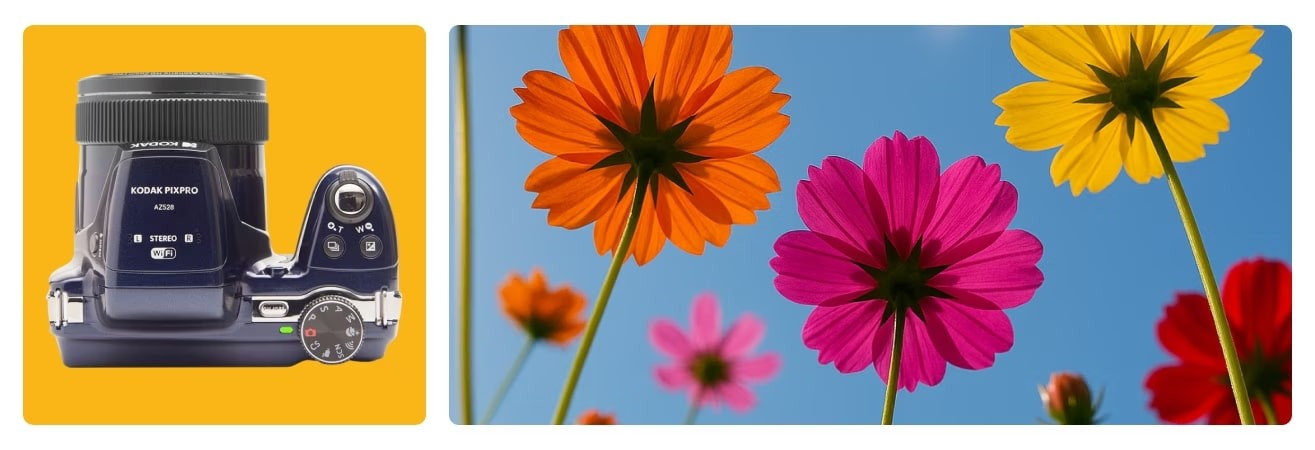
The Kodak PixPro AZ528 is a good example. It features a 52x optical zoom, allowing you to get close to distant subjects without losing quality. It's ideal for travelling, wildlife photography or even sports events. Its ergonomics are similar to those of an SLR, but everything is simplified. It's an all-in-one format that's easy to carry and use.
How to get started with a DSLR camera
Switching to a DSLR can be daunting at first, but it's also a great opportunity to learn how to take better photos. The camera isn't everything. Understanding a few important concepts will help you progress quickly.
Understanding the three basic settings
Before switching to manual mode, it's useful to know what the ISO, aperture and shutter speed are. These three settings control the amount of light entering the camera.
The ISO controls the sensitivity of the sensor. The higher it is, the more light the camera captures, but with a risk of digital noise. Aperture controls the amount of light entering the lens and also influences depth of field. Finally, shutter speed determines how long the light hits the sensor. A fast speed freezes movement, while a slow speed accompanies it or creates artistic blur.
These concepts may seem technical, but they quickly become second nature with a little practice. For example, a photo of a moving subject, such as a cyclist, will require a fast shutter speed. A landscape at dusk will require a wider aperture and a tripod.
Working with light and composition in your photography
A good photo is not just about settings. What often makes the difference is how you observe the scene. First of all, light deserves your full attention. It changes everything in the final result. When shooting outdoors, it's best to shoot at the beginning or end of the day, when the light is softer and warmer. In the middle of the day, a shady spot can sometimes offer much better results than direct sunlight.
Next comes the question of framing. This is where the famous rule of thirds comes in. It involves imagining your image divided into nine equal parts, using two vertical lines and two horizontal lines. Place the main subject on one of these lines, or at the intersection of two of them. This will create a more balanced and pleasing image. It's a simple but effective trick.
Finally, don't be afraid to move around. Sometimes, slightly changing your position or angle can completely transform the photo. Lean forward, move up a notch, step back. An ordinary subject can become much more lively if you look at it differently.
DSLR or bridge camera? How to choose according to your needs?
There are many cameras available today, so it can be difficult to make an informed choice. So should you invest in an SLR, or opt for a bridge camera that is easier to use?
The SLR, for those who want to control everything
More than just a technical device, the SLR often becomes an extension of the photographer's eye. It not only allows you to capture what you see, but also to tell a story in your own way. For videographers, bloggers, or visual storytelling enthusiasts, it's a real playground for experimentation.
With its controlled depth of field, accurate colour rendering, and the ability to change lenses depending on the desired style, the SLR offers great artistic freedom. You can switch from an intimate portrait to a more raw urban scene, from a natural setting to content designed for social media. It is this versatility that is attracting more and more creators.
Used in manual or assisted mode, it also encourages you to move beyond the simple automatic ‘click’. You take the time to compose, observe the light and adjust the details. This slower, more structured approach to the image helps you develop your eye and assert your visual style with greater accuracy.
The bridge camera: a real alternative for versatile use
If you're looking for a high-performance camera that's easier to use, the bridge camera is an excellent option. It has the same shape as an SLR, but with a fixed, versatile lens. Its main advantage is that it's ready to use, with no complicated settings or multiple accessories.
Bridge cameras are well suited to travellers who don't want to be weighed down, parents who like to capture everyday memories, or demanding beginners who want to go beyond what a smartphone can offer.
They allow you to zoom in far, manage light well, and take sharp photos in many situations. All with minimal effort and a much gentler learning curve than an SLR.
Compare what matters when choosing between a DSLR camera and a bridge camera
The choice between an SLR and a bridge camera often depends on how you take photos. When travelling, for example, an SLR can offer great creative freedom, but requires more space and care (lenses, maintenance, weight). A bridge camera, on the other hand, fits in a rucksack and meets most needs without any fuss.
In terms of budget, an SLR with several lenses can quickly exceed several hundred pounds. A bridge camera, on the other hand, remains affordable, offering great value for money for family, occasional or creative use.
In terms of autonomy, the two cameras are equal. But the bridge camera often has the advantage of immediate simplicity, with no need to know all the settings to take a great photo.
Choosing the camera that suits you
Choosing between a DSLR camera and a bridge camera is not just a matter of comparing technical specifications. It is above all a question of needs, practice and desire. The SLR offers great freedom, comprehensive settings and image quality that meets the expectations of enthusiasts. It appeals to those who want to learn, construct an image and convey a point of view.
But if you're looking for more portability and less hassle, and want a camera that's easy to use on a daily basis, a bridge camera is still a great choice. Its versatility, built-in zoom and easy handling make it an excellent compromise for exploring photography without pressure.
The most important thing is to enjoy taking photos, keep an eye out for interesting subjects and maintain your enthusiasm.